There are lakes a fisherman visits.There are lakes he learns.And every once in a while, if he's fortunate, there is a lake that becomes part of the rhythm of his life.Lake Mohave is that lake for Paulette and me.After following the Colorado River more than a thousand miles through the Rocky Mountains, Colorado ranch country, Utah red rock, Lake Powell, Grand Canyon and Lake Mead, our journey has finally brought us into water that feels less like a destination and more like coming home.Our winter place, Casa Codorniz/High Chaparral, sits about a mile and a half up the eastern slope from Katherine Landing at the base of Arizona's Black Mountains.From there Lake Mohave is not a vacation we plan six months ahead.It's the lake down the hill.That's a wonderful thing for an old fisherman.When the weather cooperates, I can look toward the mountains in the morning, check the wind, look at Paulette and say something along the lines of:"Looks pretty good out there."She already knows what that means.Before long we're headed down toward Katherine Landing with fishing rods, cameras and considerably more tackle than two people could reasonably need.Some habits have survived old age quite well.Lake Mohave is our favorite winter fishing lake. Lake Havasu would probably be next, with Lake Mead getting several spring visits when the bass begin spawning.But Mohave is different.I've spent enough days on this water to know what particular points look like when the lake rises five feet, which coves protect us from a north wind, where spring smallmouth begin appearing, and how deceptive that beautiful clear water can be.Gin-clear water makes sight fishing possible.It also gives a bass plenty of opportunity to examine the fisherman.That keeps things interesting.And there is nowhere I'd rather continue our journey down the Colorado River.
From Hoover Dam Into Black Canyon
Lake Mohave begins below Hoover Dam.Technically, the upper portion is still recognizably the Colorado River.Cold water released from deep in Lake Mead enters Black Canyon and flows south between steep canyon walls before gradually spreading into the larger reservoir.Nevada Department of Wildlife describes Lake Mohave as approximately 64 miles long, covering about 30,000 surface acres, with depths reaching roughly 120 feet. The upper 20 miles lie in Black Canyon, where deep-water releases from Hoover Dam keep the water cold throughout the year. (NDOW)That creates one of the lake's defining characteristics.Lake Mohave is really two fisheries stitched together.The upper lake is colder, narrower and more river-like.The lower lake becomes wider, warmer and more like the desert bass reservoir I know so well.Drive a boat from Willow Beach south toward Katherine Landing and you can almost feel that transformation happening.The walls spread apart.The water warms.Bass habitat improves.Then the Black Mountains rise above us to the Arizona side and the Newberry and Eldorado country frames Nevada to the west.It is one gorgeous piece of the Colorado River.For readers who want the longer background story, my Lake Mohave history article follows the reservoir from Davis Dam construction through its development as a major Colorado River recreation lake.
Davis Dam Creates Lake Mohave
Lake Mohave exists because of Davis Dam, completed on the Colorado River in 1951.The dam lies just north of Bullhead City, Arizona, and Laughlin, Nevada, roughly 67 river miles downstream from Hoover Dam.Originally known as Bullhead Dam, it was renamed in honor of Arthur Powell Davis, who served as director of the Bureau of Reclamation. My earlier Colorado River Davis Dam and Lake Mohave guide explores that lower end of the lake in more detail.Water released through Davis Dam continues south through Bullhead City and Laughlin toward Needles, Topock Gorge and eventually Lake Havasu.That gives Lake Mohave an important place in the Colorado River chain:Lake Mead → Hoover Dam → Lake Mohave → Davis Dam → Colorado River → Lake Havasu.One river.Very different lakes.
Lake Mohave Water Levels in 2026
Compared with Lake Mead, Lake Mohave's water-level story is refreshingly different.Lake Mead may fluctuate across enormous vertical distances during long drought periods.Lake Mohave is operated much more tightly.The Bureau of Reclamation's 2026 Annual Operating Plan calls for Lake Mohave to be regulated between approximately 633 and 645 feet elevation.On August 23, 2026, Reclamation's daily record showed the lake around 642.7 feet. (USBR)That doesn't mean the shoreline stays put.Twelve feet of vertical change is plenty when you're fishing shallow bass.A spawning shelf that lies beneath six feet of clear water in April might be dry rock at another lake elevation.A brush line may disappear beneath twenty feet.A gravel spawning flat can move dramatically relative to the shoreline.So even on our home lake, I don't fish memories.I fish today's water.That's especially important during the smallmouth spawn.
Lake Mohave Feeder Tributaries
Lake Mohave is different from many reservoirs because there are no major perennial tributaries entering between Hoover and Davis dams comparable to the Green, Gunnison, San Juan or Virgin rivers we've encountered farther upstream.The Colorado River itself is overwhelmingly the primary source.Along the lake, however, dozens of desert washes and side canyons drain the surrounding Black, Newberry and Eldorado mountain country.Most are dry much of the year.Then a monsoon storm arrives.That's when desert hydrology earns respect.A drainage that looked like harmless sand at noon can deliver muddy runoff, debris and surprisingly strong current by afternoon.Those washes create small coves, cuts and irregular shoreline structure that bass anglers learn to examine closely.
Lake Mohave Geography: A Lake of Contrasts
Lake Mohave has always fascinated me because the landscape changes so dramatically from north to south.The upper lake belongs to Black Canyon.Rock walls rise directly from cold, deep water.Hot springs, caves and side canyons punctuate the route.Farther south the reservoir opens.Cottonwood Basin widens dramatically.Then the lake narrows and twists through additional canyon reaches before approaching Katherine Landing and Davis Dam.Our Colorado River Guide article A Lake of Contrasts captures the geological personality especially well.NPS traces the surrounding geology back more than a billion years, through ancient seas, volcanic activity, Basin-and-Range faulting and finally erosion by the developing Colorado River. Some exposed gneiss, schist and granite around the recreation area are roughly 1.7 billion years old. (National Park Service)I've spent enough years looking at those mountains that I sometimes forget how astonishing they are.Then evening light hits them.Everything changes.The rocks that appeared gray and brown at noon turn gold, red and purple.That's when the fisherman in me occasionally loses an argument with the photographer.
Ancient People and the Colorado River
This lake may be less than a century old.The human relationship with this river is far older.National Park Service archaeology documents human occupation throughout the greater Lake Mead-Lake Mohave region going back roughly 8,000 to 10,000 years. Early peoples hunted, gathered native plants and later practiced farming along the river. (National Park Service)For the Mojave people, the Colorado River was central.NPS cultural history prepared with the Fort Mojave Indian Tribe describes traditional Mojave country as extending from Black Canyon south toward the Picacho Mountains, straddling the Colorado River. (National Park Service)These weren't people visiting the Colorado for a weekend.The river was home.Food.Agriculture.Travel.Trade.Identity.Mojave communities developed farming techniques suited to the river's floodplain and established trade routes that extended west across the desert toward the Pacific coast. (National Park Service)Today we tend to describe the river in acre-feet, megawatts and recreation statistics.Those are useful measurements.They are not the whole story.
Bullhead City and Laughlin: Our Southern Lake Mohave Gateway
At the lower end of Lake Mohave, the Colorado River runs between two communities that have become inseparable in my mind.Bullhead City, Arizona sits on the east side.Laughlin, Nevada sits directly across the river.The contrast is wonderful.Bullhead City spreads along the desert river valley.Across the water, Laughlin's hotels and casinos rise beside the Colorado.Davis Dam sits immediately upstream.Katherine Landing is only a short drive north.For Paulette and me, Bullhead City provides most of the everyday conveniences we need during winter, while Katherine Landing provides the doorway to the lake.Just below Davis Dam lies Davis Camp, another Colorado River recreation landmark. Readers continuing downstream can visit my Colorado River Davis Camp Bullhead City guide for beaches, camping, boating and fishing immediately below the dam.
Katherine Landing: Our Front Door to Lake Mohave
Now we're really home.Katherine Landing sits on the Arizona side of the lower lake.NPS describes it as a full-service recreation center offering marina facilities, fuel, boat rentals, lodging, camping and fishing access. The launch ramp is currently open with two concrete lanes. (National Park Service)The campground has 173 sites, while the RV park offers full hookups. (National Park Service)There are also coves.Lots of them.NPS says Katherine Landing provides access to 198 coves.That sounds excessive until you've spent time here.Then it sounds about right.Turkey Cove.Princess Cove.Cabinsite Cove.Telephone Cove.Sand Cove.And dozens of little cuts without names that can still hold fish.I have spent more mornings than I can count leaving Katherine Landing while the mountains were barely beginning to catch sunlight.That never gets old.
Cottonwood Cove
Roughly midway up Lake Mohave, Cottonwood Cove provides the main developed access from Nevada.NPS lists a marina, fuel, launch ramp, motel, camping, RV facilities and houseboat rentals.The current launch ramp remains open with six concrete lanes. (National Park Service)Cottonwood Basin surrounding it is some of the lake's broadest water.That makes weather especially important.A strong north or south wind can build enough fetch across open water to produce uncomfortable, and sometimes dangerous, conditions.I've spent too many years around boats to argue with wind.When Mohave begins standing up, I head for protected water.
Willow Beach and Black Canyon
At the upper end, Willow Beach sits deep in Black Canyon.The current launch ramp is open with three concrete lanes. (National Park Service)This is a completely different Lake Mohave.The water is cold.Canyon walls rise steeply.Rainbow trout and large stripers have historically drawn fishermen here.This is also a famous paddling area.The Black Canyon National Water Trail provides access to coves, hot springs and places such as Emerald Cave.NPS manages Sunday and Monday as primitive boating days upstream of Willow Beach, prohibiting motorized vessels and personal watercraft in that section so paddlers can enjoy a quieter experience. (National Park Service)If I want solitude with a kayak, that's hard to beat.
Rafting, Kayaking and Paddling the Colorado River
Lake Mohave itself isn't primarily a whitewater rafting destination.The Colorado entering the lake below Hoover Dam is more famous for float trips, kayaking and rafting through Black Canyon.Commercial and private paddle trips can explore the clear water, volcanic canyon walls, springs and beaches between Hoover Dam and Willow Beach.Below Willow Beach the reservoir gradually widens and motorboat traffic becomes more common.For someone who wants to experience Lake Mohave without a bass boat, this upper section may be the finest introduction.You're sitting almost at river level.Every cliff looks taller.Every little cove becomes an invitation.
The Fish of Lake Mohave
NDOW lists Lake Mohave sportfish including:
- Striped bassLargemouth bassSmallmouth bassRainbow troutChannel catfishBluegillCrappie
Native and protected fishes include the endangered razorback sucker, for which Lake Mohave remains important habitat. (NDOW)For me, however, the heart of Lake Mohave fishing comes down to three species:Smallmouth bassLargemouth bassStriped bassAnd I suppose nobody who knows me will be surprised that smallmouth come first.
January: Deep Water, Clear Water and Patience
January is winter finesse fishing.Bass metabolism is slower.The water is clear.Fish often relate to steep points, ledges, channel swings and broken rock with quick access to deep water.For smallmouth I concentrate roughly between 20 and 50 feet, though fish can certainly move shallower during favorable warming periods.My winter spinning outfit:Rod: 6'10" to 7'3" medium-light spinning rod
Reel: 2500-size spinning reel
Main line: 8- to 10-pound braid
Leader: 6- to 8-pound fluorocarbonLures:
- 2¾- to 3½-inch Ned rigs3- to 4-inch tubes3½- to 4½-inch drop-shot wormsSmall football jigsSmall swimbaits
Colors:Green pumpkin.Brown.Smoke.Watermelon.Natural shad.Lake Mohave gives bass plenty of time to inspect bad decisions.Subtle usually wins.
February: Watching for the First Move
February begins making me optimistic.A string of sunny days can warm protected coves several degrees above the main lake.Bass begin staging closer to spring spawning areas.This is where I start working secondary points and transition banks leading toward shallow gravel.Suspending jerkbaits become important.I like 3½- to 5-inch jerkbaits in ghost shad, translucent silver, natural minnow and occasionally chartreuse combinations if conditions reduce visibility.Cold water means longer pauses.Sometimes painfully long pauses.The fish will tell me when I'm moving too fast.
March: Pre-Spawn Smallmouth Arrive
By March, things get serious.The March 18, 2026 NDOW report noted an increase in Lake Mohave smallmouth activity as fish moved toward spawning beds, with jigs and craws on drop-shot rigs producing fish as large as four pounds. Anglers were also getting strikes on jerkbaits and glide baits. (NDOW)That's exactly the Lake Mohave I recognize.Water in the upper 50s begins pulling fish shallow.When it reaches the low 60s, I start looking very carefully.Points leading into spawning coves.Hard-bottom shelves.Gravel.Broken rock.Protected pockets.And sunlight.Spring is coming.
April: My Favorite Lake Mohave Fishing
Now we're talking.Lake-Mohave.com recorded one of our April smallmouth trips when the water had warmed into the mid-60s, and sight fishing in that crystal-clear water had become tremendous fun. (Lake Mohave)That's Lake Mohave at its best for me.I deploy the trolling motor before entering a likely spawning area.From there we're quiet.The Yamaha is off.No slamming lids.No unnecessary movement.Polarized glasses go on.Then I start looking.Beds often appear as light patches against darker bottom.Sometimes I see the bed first.Sometimes the bass.Sometimes just the shadow.Once I locate a fish, I back the boat away.Clear water punishes fishermen who get greedy about distance.Then comes the cast.Ned rigs.Tubes.Small craws.Drop shots.Compact creature baits.For sight fishing I often like white, not because I believe it possesses mystical powers but because I can see exactly where that lure is relative to the nest.Watch the bass.Watch the bait.That's fishing with the curtains open.
May: Post-Spawn and Largemouth Time
By May, spawning activity varies across the lake.Some smallmouth remain on beds.Others guard fry.Lake-Mohave.com has documented male smallmouth guarding newly hatched fry above their nests in late April, exactly the kind of behavior careful anglers may encounter into May. (Colorado River Guide)Largemouth also become increasingly interesting.I look for the warmest protected coves, available brush, flooded terrestrial vegetation, rock transitions and shade.Lake Mohave doesn't provide acres of hydrilla or milfoil like a Southern bass reservoir.Vegetation is limited and fluctuating.Therefore, the best available cover becomes disproportionately valuable.
June: Bass Follow Forage
June is transition season.Smallmouth increasingly follow bait toward points, ledges and main-lake structure.Largemouth use protected coves early and move deeper as the sun climbs.Topwater can be excellent first thing.Then jerkbaits.Swimbaits.Crankbaits.Finally finesse plastics as fish move deeper.I follow the bass down rather than insisting they remain where I wanted them to be.That's saved more fishing days than any particular lure.
July and August: Desert Rules Apply
Summer on Lake Mohave is serious.NPS says temperatures routinely exceed 100°F from June through August, while local Lake Mohave information notes that afternoon temperatures can exceed 110°F. (National Park Service)I have nothing to prove to August.I fish early.Sometimes very early.Summer black bass often use deeper rock, points, submerged shelves and shade.Stripers become a major target because they follow schools of shad through open water.Electronics become essential.Find forage.Find stripers.
September: Watching for the Fall Turn
September is still hot, but the first hints of change begin appearing.Bass respond to baitfish movements.Smallmouth may move toward shallower rocky points during favorable periods.Striper action can improve dramatically around schooling shad.I watch for birds.If gulls or terns are suddenly focused on one patch of water, I stop being philosophical about nature and start reaching for a topwater rod.
October: Prime Striper Time
Lake-Mohave.com identifies April through November as the broad striper season, with October historically considered the peak. (Lake Mohave)This is when I think:Topwaters.Swimbaits.Spoons.Shad.Early morning.Evening.When stripers push threadfin shad toward the surface, Lake Mohave can suddenly look as though someone turned on a washing machine.Cast beyond the boil.Bring the lure through the fish.And hang on.
November: One of My Favorite Quiet Months
November is beautiful.The worst heat is gone.Pleasure-boat traffic declines.Bass become increasingly active as the water cools.Stripers remain available.We've enjoyed more than a few November afternoons on this lake, fishing until the desert evening became too chilly to ignore.Smallmouth often move through the 10- to 30-foot zone following forage.Jerkbaits and finesse plastics come back to the front of the deck.
December: Winter Comes Back Around
December returns us to slower presentations.Deep points.Rock walls.Channel edges.Vertical structure.Drop shots and Ned rigs.Stripers remain catchable, but fish may school deeper depending upon forage.The lake grows quiet.And I like it that way.Winter desert water has a stillness that summer never quite manages.
Lake Mohave Smallmouth Bass Tackle
For smallmouth, my foundation is spinning tackle.Rod: 6'10" to 7'3" medium-light or medium
Reel: 2500-size
Main line: 8- to 10-pound braid
Leader: 6- to 10-pound fluorocarbonBest lures:
- 2¾- to 4-inch Ned rigs3- to 4-inch tubes3½- to 5-inch drop-shot wormsSmall craws3- to 4-inch swimbaitsSuspending jerkbaitsSmall walking topwatersCompact football jigs
Colors:Green pumpkin.Brown.Smoke.Watermelon.Natural crawfish.Shad.Pearl.White for sight fishing.Depth may vary from inches during the spawn to 40 feet or more during winter and summer.The great advantage of Mohave is visibility.The great disadvantage of Mohave is visibility.The fish can see us too.
Lake Mohave Largemouth Bass Tackle
For largemouth I step up to a heavier outfit.Rod: 7-foot medium-heavy casting rod
Reel: 7:1 baitcaster
Line: 12- to 17-pound fluorocarbon; braid where heavier cover warrants itLures:
- ⅜- to ½-ounce jigsTexas-rigged wormsCreature baitsSpinnerbaits4- to 5-inch swimbaitsCrankbaitsJerkbaitsTopwater plugs
Colors:Green pumpkin.Watermelon.Black-and-blue when I want contrast.White or shad combinations.Crawfish browns.March through June has historically been Lake Mohave's strongest general largemouth period. (Lake Mohave)
Lake Mohave Striped Bass Tackle
Stripers require different tools.Rod: 7- to 7½-foot medium-heavy
Reel: 3000-4000 spinning reel or sturdy baitcaster
Line: 15- to 30-pound braid depending upon presentation and fish sizeLures:
- ¾- to 2-ounce spoons4- to 8-inch swimbaitsGlide baitsTopwater walking baitsPoppersBucktail jigsTrout-pattern plugs in the upper lake
Colors:White.Pearl.Silver.Chrome.Threadfin shad.Rainbow trout patterns near Willow Beach.The March 2026 NDOW report noted anglers around Willow Beach catching stripers over 20 pounds on AC Plugs, reminding everyone that genuine trophy fish still live here. (NDOW)During daylight, stripers may hold 40 to 100 feet deep, while low-light conditions often draw them shallower. (Lake Mohave)Electronics are not optional when the fish are deep.They are the map.
Aquatic Vegetation, Habitat and Structure
Lake Mohave is not a grass lake.The primary habitat is geological.Rocky points.Gravel flats.Boulder fields.Canyon walls.Submerged ledges.Old river channels.Pockets.Cuts.Drop-offs.Flooded washes.The limited aquatic and terrestrial vegetation that does become inundated can be extremely valuable, particularly for largemouth.Smallmouth are much more comfortable relating directly to rock.That's why I spend so much time looking for:Gravel meeting boulders.Flat shelves beside sharp drops.Small rock transitioning to chunk rock.A channel swing touching a point.A lone boulder on otherwise featureless bottom.One irregularity can hold several fish.
Lake Mohave Fishing Records
Lake Mohave has produced some impressive fish.The headline belongs to Allan Cole's 63-pound striped bass, caught March 15, 2001.Nevada's official state-record book lists the fish at 63 pounds and 49 inches, and it remains Nevada's state-record striped bass. (NDOW)That is one magnificent striper.Lake Mohave's recognized water records also include:Largemouth bass: 11 pounds, caught in 1972.Smallmouth bass: 7 pounds, 6 ounces, caught by Tim Myers in 2019.Rainbow trout: 16 pounds, 4 ounces.Channel catfish: 26 pounds, 4 ounces.Black crappie: 2 pounds, 12 ounces. (NDOW)That 7-pound-6-ounce smallmouth gets my attention.A seven-pound Lake Mohave smallie in clear water is the sort of fish that can make a grown fisherman forget half his vocabulary.
Catch and Release
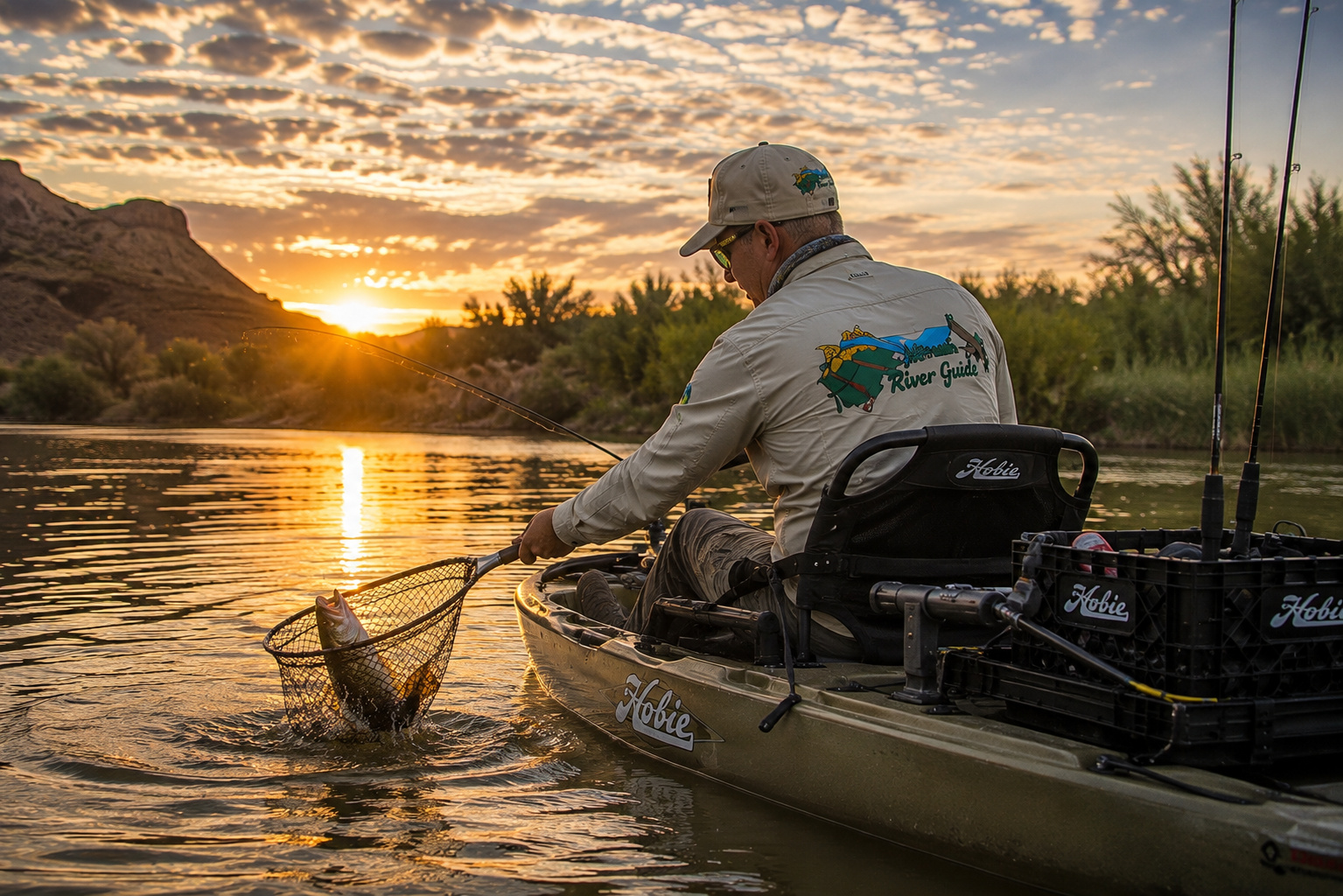
At this stage of my fishing life, catching the fish is only part of the pleasure.Watching it swim away matters just as much.For bass I'm releasing, particularly during the spawn, I try to minimize handling.Get the fish in quickly.Wet my hands.Lip it properly.Support a large fish horizontally when necessary rather than hanging its entire body weight from the jaw.Take the photograph.Release it.If the fish came from a spawning bed, I want it back there quickly.That fish may be protecting eggs or fry.I don't need twenty photographs.One good frame is enough.A trophy bass disappearing back into clear Lake Mohave water is one of my favorite endings to any fishing story.
Wildlife Around Lake Mohave
Fishing rods aren't the only reason we keep cameras aboard.The lake lies in tremendous wildlife country.I especially watch for:Desert bighorn sheepMule deerCoyotesBobcatsMountain lionsDesert tortoisesChuckwallasJackrabbitsCottontailsBatsAlong the water:Bald eagles during winterGolden eaglesOspreysPeregrine falconsRed-tailed hawksGreat blue heronsCormorantsWaterfowlA bighorn sheep standing high on a Black Mountain ridge can stop our fishing immediately.Somewhere there is probably a bass wondering why we suddenly left.
Public Access and Boat Ramps in 2026
As of late August 2026, NPS lists all three principal Lake Mohave launch ramps as operable:Willow Beach: three concrete lanes.Katherine Landing: two concrete lanes.Cottonwood Cove: six concrete lanes. (National Park Service)That makes Mohave much easier to access currently than some of the low-water ramps we've encountered farther upstream.Additional small-craft access exists around Telephone Cove and other shoreline areas. The Colorado River Heritage Trail at Lake Mohave offers another way to explore the surrounding landscape on foot.
Camping on Lake Mohave
Lake Mohave offers everything from developed campgrounds to primitive shoreline camping.Current NPS options include:Katherine Landing Campground, 173 sites.Cottonwood Cove Campground, 45 standard sites in the current NPS listing, plus concession-operated RV facilities.Willow Beach Campground, with additional camping and RV facilities farther north. (National Park Service)Katherine Landing and Cottonwood Cove also provide concession-operated RV parks with hookups.Primitive and backcountry camping is available in designated areas under park regulations. (National Park Service)Personally, I have always liked camping where I can hear water.A cove after dark has its own soundtrack.Water against rock.An occasional fish breaking the surface.Maybe a coyote somewhere in the hills.You don't need much more.
Weather Through the Seasons
Winter
Winter is why we're here.Daytime temperatures can be wonderfully comfortable.Nights may approach freezing.Cold fronts bring strong north winds.The lake can go from mirror-smooth to ugly surprisingly fast.But a sunny January afternoon on Lake Mohave is one of the reasons Paulette and I escape New Mexico snow.
Spring
Spring is my favorite fishing season.Water warms.Smallmouth move shallow.Largemouth begin spawning.Desert flowers may appear after wet winters.And those gin-clear coves become sight-fishing country.March through May is difficult to beat.
Summer
Summer belongs to early birds.Temperatures commonly exceed 100°F and can climb above 110°F.Fish dawn.Carry more drinking water than seems necessary.Use sunscreen.Wear protective clothing.Watch engine temperature and batteries.And respect monsoon thunderstorms.
Fall
Fall is another wonderful season.Temperatures moderate.Stripers feed.Bass follow shad.Recreational traffic declines.Morning and evening light improves.By November, the lake begins feeling like ours again.
Getting to Lake Mohave
Lake Mohave can be approached from several directions.
From Bullhead City and Laughlin
Katherine Landing is the natural gateway.From Bullhead City, follow the Katherine Landing road north into Lake Mead National Recreation Area.Laughlin visitors simply cross the Colorado River into Arizona and continue toward Katherine Landing.NPS places Laughlin about 7.5 miles from Katherine Landing and Bullhead City about 10.8 miles away. (National Park Service)
From Las Vegas
Willow Beach is reached by U.S. Highway 93 south toward Hoover Dam and the Arizona side.Cottonwood Cove is accessed through Searchlight, Nevada.
From Searchlight
Cottonwood Cove sits roughly 14 miles east of town at the end of Cottonwood Cove Road.The road drops dramatically from desert upland toward the lake.The first glimpse of blue water below the mountains is always a good one.
Our Winter Backyard
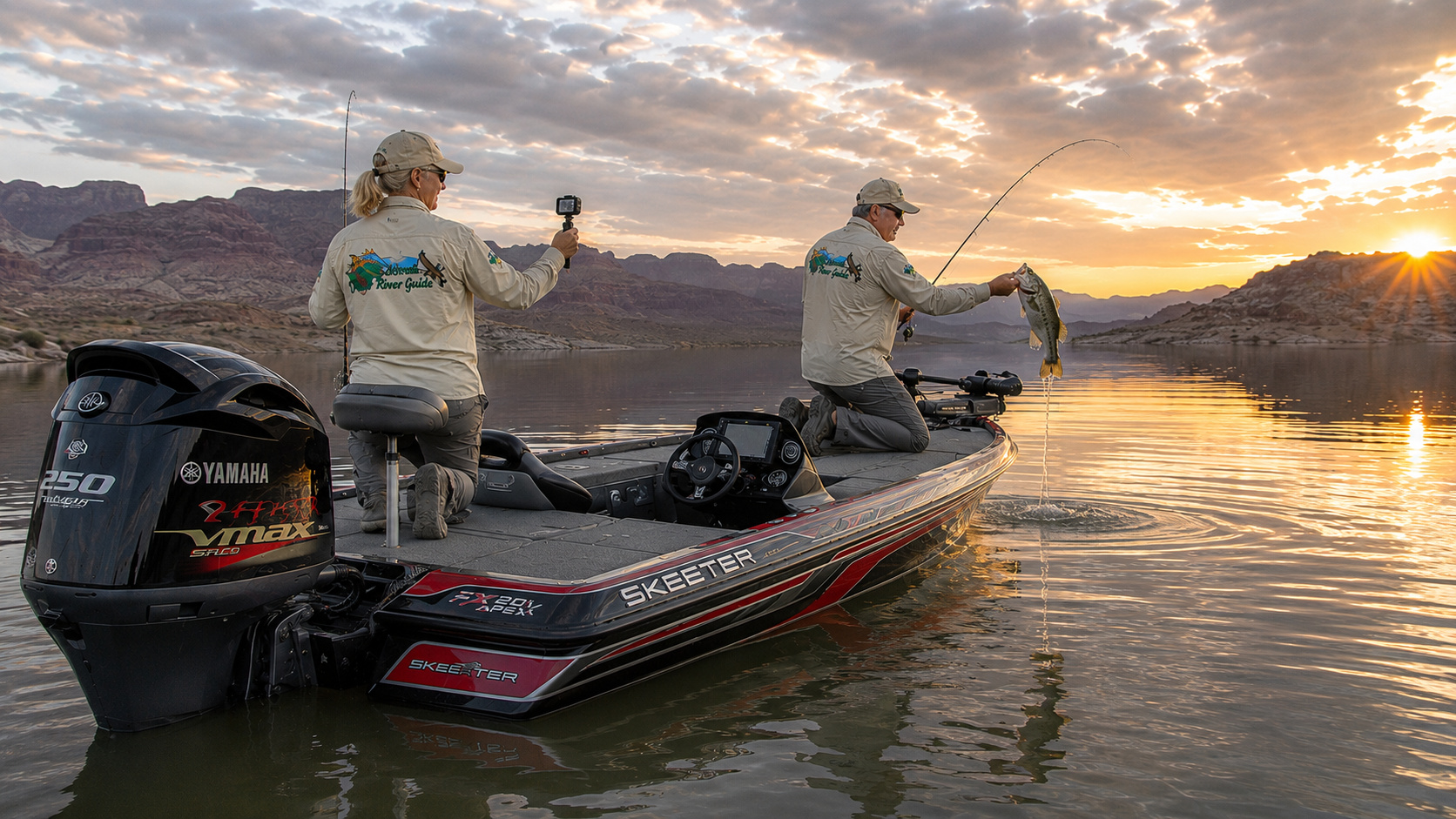
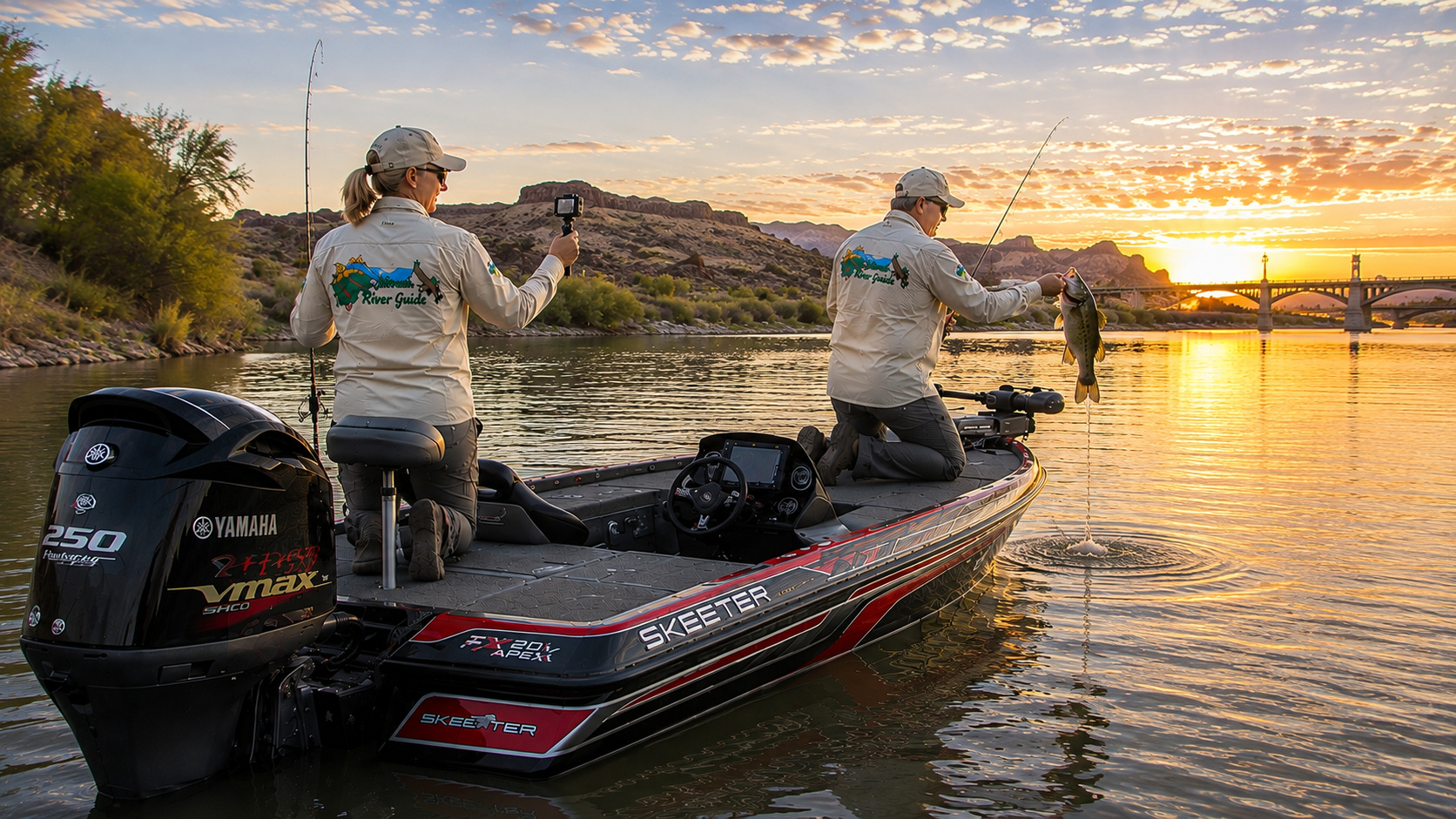
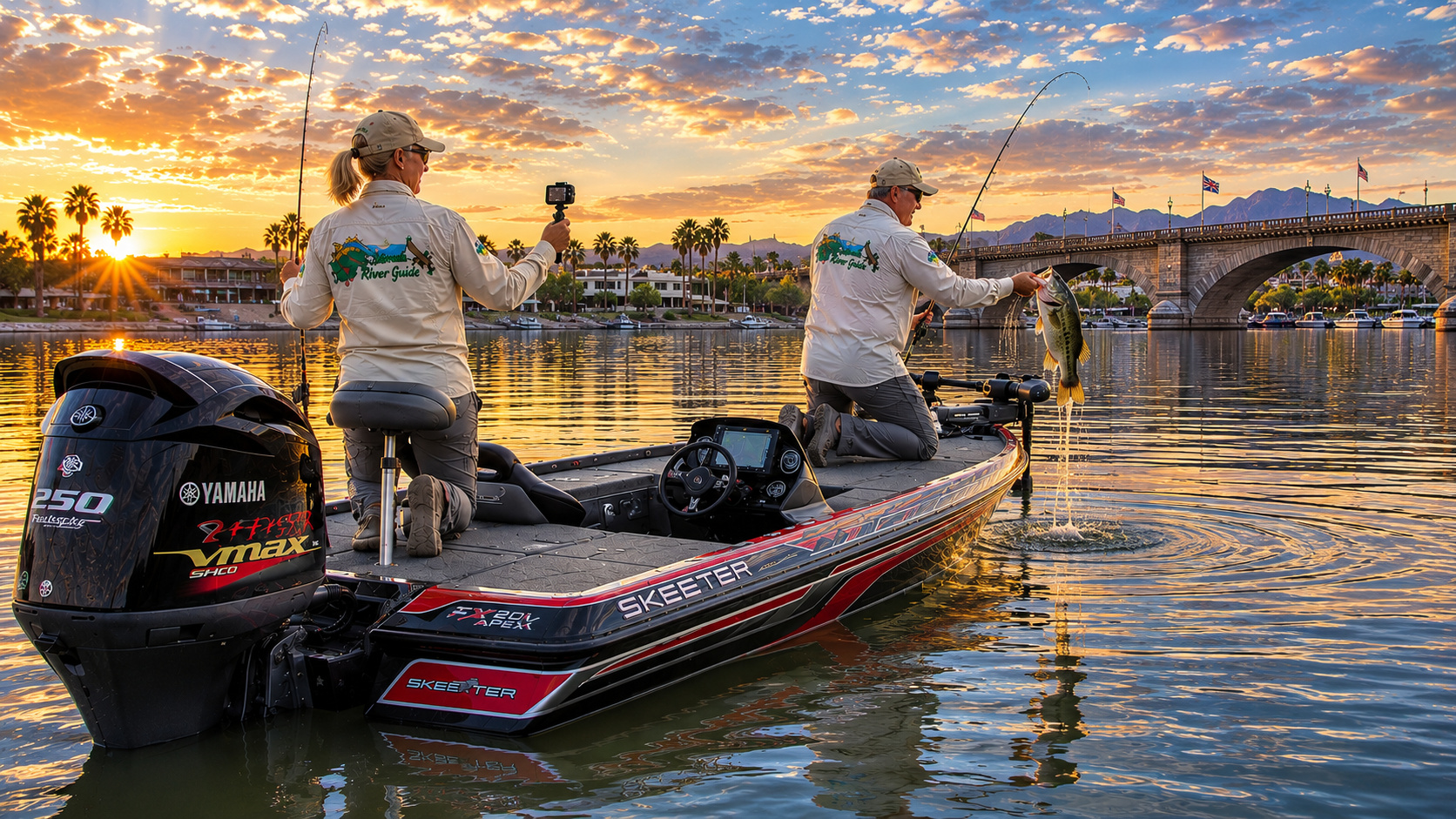
After following the Colorado River for all these miles, this is the first chapter where I don't have to imagine how the water feels.I know.I know the jade-green clear water.I know Katherine Landing before sunrise.I know how the Black Mountains glow when the first light reaches them.I know the sudden silence when the Yamaha shuts down and the trolling motor slips into the water.I know how a smallmouth bed looks through polarized glasses in fifteen feet of clear water.I know how Paulette sounds when she spots a fish before I do."There's one."Naturally, that always gets my attention.I ease the boat around.There she is.Bronze.Good fish.Holding beside a pale circle of gravel.The Skeeter stops.Trolling motor still deployed.I kneel near the bow.One hand holds the rod.The other reaches down.The smallmouth comes partly out of that clear water, tail still dripping.For one brief moment everything is exactly right.The fish.The boat.The lake.The mountains.Paulette with the camera.Then the bass goes back.One kick.Gone.And I can still see her swimming beneath us.That's Lake Mohave.
The Colorado River Continues
Below Davis Dam, our river leaves the lake and flows directly between Bullhead City and Laughlin.Then it travels south toward Needles and Topock Gorge.Lake Havasu waits downstream.The country changes again.But now we're traveling water we've known for years.That makes these final Colorado River chapters particularly special to me.The great river that began in Rocky Mountain snow has finally reached our winter backyard.I suppose that's one reason I never tire of looking across Lake Mohave.I know where that water has been.And I know where it's going.For the entire journey, readers can return to my Colorado River from the Rocky Mountain Headwaters to the Gulf of California overview.But for tonight?I'm content right here.The sun is dropping behind the Newberry Mountains.The Skeeter is tied up.The rods are put away.Lake Mohave has turned dark blue.Tomorrow morning we'll probably fish again.At my age, I've learned not to postpone perfectly good mornings.And this is home water.
Pat is a writer, photographer, and videographer documenting the wilderness and wildlife of the American Southwest. His work focuses on the mountains, deserts, rivers, and trails of New Mexico, Arizona, Utah, and Colorado. He and his wife Paulette divide their time between Santa Fe, New Mexico and Lake Mohave, Arizona.
0 Comments