There comes a point on a long journey when unfamiliar country begins giving way to familiar landmarks, familiar weather and, best of all, familiar water.
For Paulette and me, Lake Mead means we have entered our winter home waters of the Colorado River.
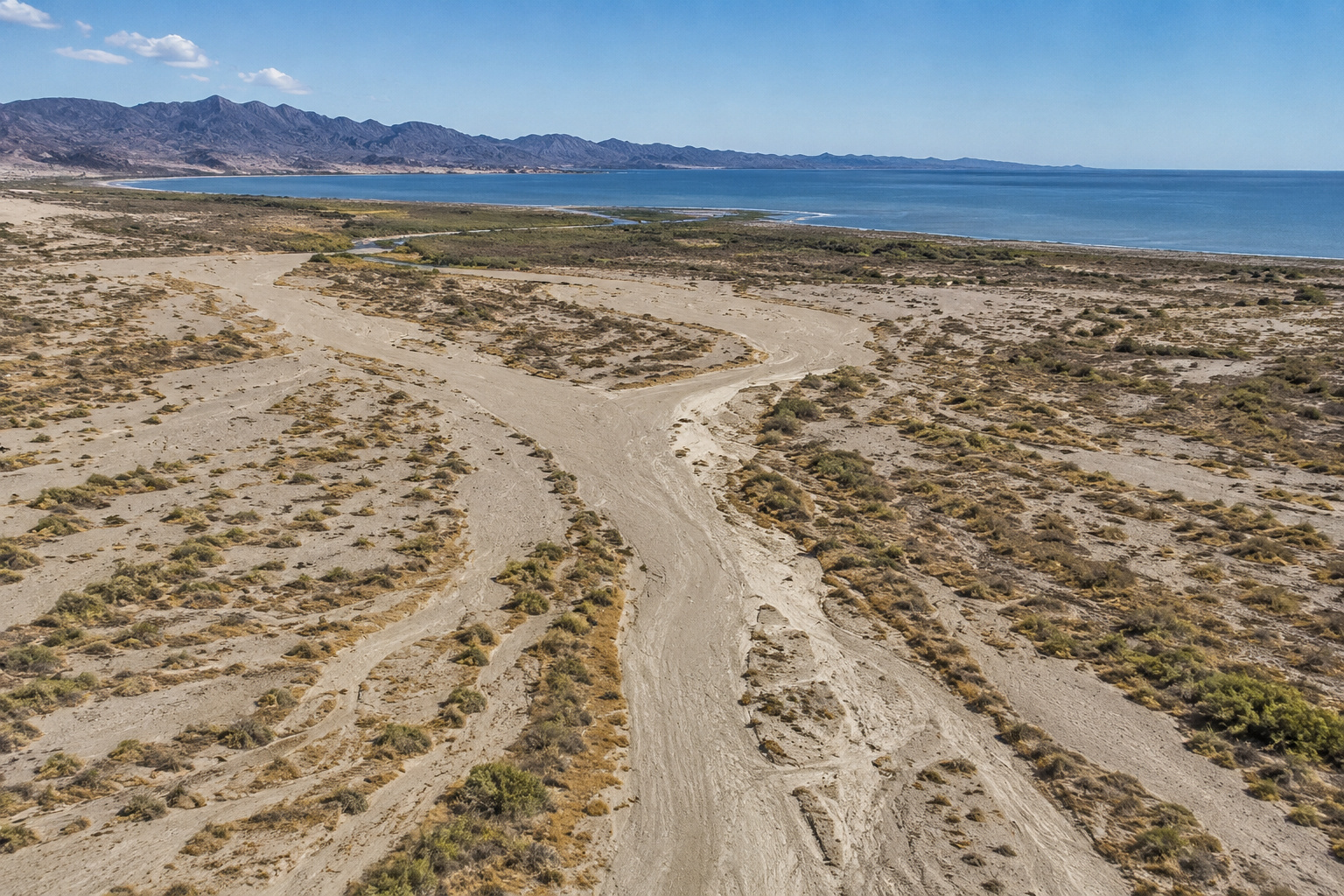
We've followed the Colorado from a cold little stream high in Rocky Mountain National Park, through Grand Lake and the mountains of Colorado, through Utah's red-rock country, Lake Powell and Grand Canyon. Now the river emerges from that tremendous canyon and spreads into one of the most famous reservoirs in the American West.
Lake Mead.
This is where the Colorado River journey becomes personal in a different way.
Lake Mead isn't our primary winter fishing lake. That honor belongs to Lake Mohave, where our winter home at Casa Codorniz/High Chaparral sits about a mile and a half up the eastern slope from Katherine Landing Marina at the foot of Arizona's Black Mountains.
We can practically smell Lake Mohave from home.
And farther downstream, Lake Havasu has become another favorite.
But during the spring spawning season, Lake Mead begins whispering to an old bass fisherman.
Come on up.
There are smallmouth moving shallow.
And that is usually all the invitation I need.
I've spent enough of my life bass fishing to have enjoyed just about every kind of strike a bass can deliver, but sight-fishing smallmouth bass in gin-clear water during the spawn remains one of my all-time favorite ways to fish.
Find a bed.
Ease the trolling motor down.
Stay back.
Watch the fish.
Make the cast.
Then watch the whole drama unfold beneath the boat.
There aren't many fishing experiences better than that.
And Lake Mead gives us plenty of country in which to do it.
The Colorado River Finally Reaches Lake Mead
Our previous journey carried us through Grand Canyon and Hualapai country toward the western end of the canyon.
Eventually those immense walls begin opening.
The Colorado emerges.
Then the river encounters something human beings placed in its path.
Hoover Dam.
The reservoir behind Hoover Dam is Lake Mead.
Completed during the 1930s, Hoover Dam transformed this stretch of the Colorado River from a canyon river into an enormous desert reservoir. Lake Mead was impounded beginning in 1935 and named for Elwood Mead, then commissioner of the Bureau of Reclamation. (NDOW)
When full, Lake Mead is an impressive piece of water.
Nevada Department of Wildlife describes it as approximately 110 miles long, covering about 150,000 acres, with a maximum depth of roughly 465 feet at full pool. (NDOW)
But those historical full-pool numbers require an important qualification.
The Lake Mead we fish today is nowhere near full.
Lake Mead Water Levels in 2026
Anyone writing about Lake Mead today has to talk about water levels.
Not as a footnote.
As part of the lake's identity.
Full-pool elevation is approximately 1,219.6 feet above sea level. On August 26, 2026, Bureau of Reclamation operational data placed Lake Mead at approximately 1,039.05 feet, nearly 181 feet below full pool, with about 6.9 million acre-feet in storage. (USBR)
That's a tremendous vertical difference.
You see it everywhere.
The famous white mineral "bathtub ring" circles the canyon walls.
Old ramps end high above the water.
Former islands become peninsulas.
Points grow longer.
Coves change shape.
Old shoreline structure becomes dry land while structure that once seemed impossibly deep becomes fishable.
For a bass fisherman, that means I never assume the Lake Mead I remember is the Lake Mead I'll find this spring.
I study current maps.
I watch my electronics.
And I pay attention to where the water meets the rock today.
The National Park Service currently warns that declining water levels have fundamentally reshaped shoreline access. As of August 2026, operable Lake Mead launches include Hemenway Harbor, Callville Bay and Echo Bay in Nevada, plus Temple Bar and a primitive gravel launch at South Cove in Arizona. Boulder Harbor remains closed to launching. (National Park Service)
That's information I check again immediately before towing the Skeeter north.
Lake Mead can move the goalposts.
Sometimes literally.
A River Still Flows Beneath the Lake
One of my favorite descriptions of Lake Mead comes from the National Park Service.
From the surface, the Colorado River seems to have disappeared into a lake.
But beneath that lake, the river continues.
The Colorado enters the Virgin Basin and moves westward through the reservoir, eventually passing through Boulder Canyon into Boulder Basin before reaching Hoover Dam. NPS estimates the Colorado supplies about 96.9 percent of Lake Mead's water. (National Park Service)
I like thinking about that while I'm sitting on the front deck.
Beneath hundreds of feet of water, somewhere down there, is the old Colorado River channel.
The river hasn't forgotten where it was going.
We've simply put a lake over it.
Feeder Tributaries of Lake Mead
The Colorado River is overwhelmingly Lake Mead's largest source of water, but it isn't alone.
Two important tributaries enter the northern portion of the reservoir:
Virgin River
and
Muddy River.
The Virgin River drains portions of Utah, Arizona and Nevada before reaching the Lake Mead basin.
The Muddy River flows through southern Nevada and joins the Virgin system near the reservoir.
Both carry sediment and nutrients into the lake. (National Park Service)
Another important drainage is Las Vegas Wash, which enters Boulder Basin from the Las Vegas Valley.
These inflows create different water conditions around the reservoir.
That matters to fish.
And what matters to fish eventually matters to fishermen.
Geography: Desert Mountains, Canyons and Water
Lake Mead occupies a landscape that doesn't look as though it ought to contain an enormous lake.
That's part of its appeal.
The surrounding country is a jumble of rugged desert mountain ranges, volcanic formations, limestone cliffs, colorful sedimentary layers, washes and canyons.
The geology reaches back more than a billion years. NPS describes a landscape shaped by ancient seas, mountain building, volcanism, faulting, erosion and eventually the Colorado River itself. (National Park Service)
The modern reservoir floods portions of several basins connected by narrower canyon sections.
For fishermen, names such as these become familiar:
Boulder Basin
Virgin Basin
Overton Arm
Temple Basin
Gregg Basin
Callville Bay
Hemenway Harbor
Government Wash
Las Vegas Wash
Echo Bay
Temple Bar
South Cove
Each has its own personality.
At today's lower elevations, however, shorelines and navigable routes can differ considerably from old maps and memories.
Ancient People Along the Colorado River
One thing this Colorado River journey has repeatedly taught me is that we should be careful with the word wilderness.
It can suggest that nobody lived here before us.
People have occupied the Lake Mead region for thousands of years.
Archaeological evidence documented by the National Park Service indicates human cultures were present here 8,000 to 10,000 years ago, when the climate was cooler and wetter. Some hunted and gathered; later peoples practiced agriculture and established settlements along the Colorado, Virgin and Muddy river systems. (National Park Service)
Ancestral Puebloan farmers grew corn, beans and squash, developing remarkably clever techniques for conserving desert moisture. (National Park Service)
The Moapa Valley contained an extensive Ancestral Puebloan settlement complex later called the Lost City. Some structures contained dozens of rooms, with one exceeding 100 rooms. Archaeologists hurried to document portions of these sites before rising Lake Mead covered some of them. (National Park Service)
That's something I think about while running a boat across the lake.
Beneath that water are not merely old river channels.
There are pieces of human history.
Long before Hoover Dam, long before Las Vegas, and certainly long before our bass boats and depth finders, people were learning how to live beside this river.
St. Thomas: A Town Lake Mead Swallowed and Returned
The old town of St. Thomas, Nevada, gives Lake Mead's fluctuating water level a human face.
Mormon settlers founded St. Thomas in 1865 near the Muddy and Virgin rivers. When Hoover Dam was completed and Lake Mead filled, residents eventually abandoned the town and water covered it. (National Park Service)
As Lake Mead later declined, ruins emerged again.
There's something almost eerie about that.
A town disappears beneath a reservoir.
Generations pass.
Then the water retreats and the desert begins giving it back.
Lake Mead keeps its own calendar.
John Wesley Powell Finally Comes Out of the Canyon
There's another piece of history here that fits beautifully into our journey.
John Wesley Powell and his exhausted 1869 expedition traveled down the Green and Colorado rivers through the unknown canyon country.
After all those rapids, damaged boats, dwindling provisions and hardships, Powell's surviving party completed its journey near the confluence of the Virgin and Colorado rivers, in country now beneath or adjacent to Lake Mead. (National Park Service)
We've essentially been retracing that water route in much greater comfort.
Powell had wooden boats and sketchy maps.
I've got a Skeeter, Yamaha, GPS mapping and side imaging.
I'm keeping my equipment.
Lake Mead Becomes a Bass Lake
Before Hoover Dam created Lake Mead, the Colorado River here supported carp, channel catfish and native fishes.
The reservoir changed that ecosystem dramatically.
Threadfin shad were introduced in 1954, helping largemouth bass flourish. Striped bass and trout were introduced later. By the 1970s, stripers had become dominant. Smallmouth bass were first documented in Lake Mead in 1999, along with tilapia; gizzard shad appeared in 2007. (NDOW)
Today NDOW lists the principal sport fishes as:
-
Striped bass
-
Largemouth bass
-
Smallmouth bass
-
Channel catfish
-
Bluegill
-
Green sunfish
-
Black crappie (NDOW)
But for this old bass fisherman, three species command most of my attention:
Largemouth bass.
Smallmouth bass.
Striped bass.
And spring smallmouth get first billing.
Why We Come to Lake Mead During the Spawn
We don't need to drive to Lake Mead to find smallmouth.
We live beside Lake Mohave during winter.
And downstream, Lake Havasu provides another tremendous bass fishery.
But each lake is different.
Lake Mead has vast amounts of rocky shoreline and, in places, beautifully clear water.
When spring warms protected coves into the spawning range, smallmouth begin moving shallow.
That's when Paulette and I start thinking about making a Lake Mead trip.
For me, sight fishing is bass fishing stripped down to its most fascinating elements.
I can see the fish.
The fish can often see me.
I know where the lure is.
I watch how the bass reacts.
Wrong angle?
Nothing.
Wrong color?
Fish backs away.
Too much movement?
She's gone.
Then you make the right cast.
The bass turns.
Fins flare.
She moves toward the bait.
And suddenly you see the white flash of her mouth.
That's fishing with the curtain pulled back.
I never get tired of it.
Lake Mead Fishing Month by Month
January: Winter Structure
January is a deep-water month.
Surface temperatures are generally near their annual lows. Bass metabolism slows, and fish often relate to steep structure with convenient access to deeper water.
I concentrate on:
Rocky points.
Channel swings.
Bluffs.
Secondary points.
Submerged ledges.
For smallmouth, I like a 7-foot medium-light spinning rod, 2500-size reel and 8- to 10-pound braid with a 6- to 8-pound fluorocarbon leader.
My first choices are:
3-inch drop-shot worms.
Ned rigs.
Small tubes.
Football jigs.
Natural colors such as green pumpkin, brown, smoke and watermelon.
Stripers remain catchable throughout winter. NDOW notes that striped bass fishing is productive year-round, with bait and topwater presentations particularly useful from November through March. (NDOW)
February: Watching the Weather
February can begin teasing us.
A series of sunny days warms protected northwestern pockets.
Bass don't immediately charge onto spawning flats, but they begin positioning closer.
I look for staging areas adjacent to shallow spawning habitat.
A suspending jerkbait can be deadly.
I like 3½- to 5-inch jerkbaits in translucent shad, ghost minnow, silver and natural colors.
Cold water means longer pauses.
The colder the water, the more patience I put between twitches.
March: Here They Come
March is when my pulse starts climbing.
NDOW's March 18, 2026 report described Lake Mead black bass already showing pre-spawn activity, with finesse plastics working in coves. (NDOW)
Exactly what I want to hear.
As water enters the upper 50s and begins approaching 60°F, smallmouth increasingly move toward spawning habitat.
I look for:
Protected coves.
Gravel.
Broken rock.
Hard-bottom flats.
Secondary points.
Shallow shelves close to deeper escape water.
This is when polarized glasses become as important as my rod.
April: Sight-Fishing Heaven
If conditions cooperate, April is why we came.
Smallmouth spawning activity often peaks somewhere within the spring warming period, although exact timing varies with weather, water elevation and location.
I ease into likely coves with the trolling motor.
Slowly.
No banging compartment lids.
No stomping around.
No dropping pliers on the deck.
I'm looking for light-colored circular areas against darker bottom.
Then I'm looking for movement.
A shadow.
A tail.
A bronze shape.
There she is.
I keep the boat well off the bed.
The clearer the water, the farther away I want to be.
A 7-foot spinning rod lets me make accurate casts without overpowering the presentation.
My bed-fishing choices include:
3- to 4-inch tubes
Ned rigs
Drop-shot plastics
Small craws
Compact creature baits
Colors?
I use natural green pumpkin and brown when fish are comfortable.
But when sight fishing, I sometimes want a bait I can see, because knowing exactly where the lure sits relative to the bed is enormously helpful.
White can be excellent for that reason.
I don't need the bass to admire it.
I need to know where it is.
May: Largemouth and Smallmouth in Transition
By May, portions of the lake may contain spawning fish, post-spawn fish and bass already moving toward early-summer patterns.
NDOW identifies May through September as the strongest general period for Lake Mead largemouth bass, particularly early and late in the day. (NDOW)
Smallmouth remain strongly associated with rock.
Largemouth are more likely to favor protected coves and whatever substantial cover is available.
This is when I broaden the tackle deck.
Texas rigs.
Jigs.
Spinnerbaits.
Crankbaits.
Swimbaits.
Topwaters.
Drop shots.
The lake is alive.
June: Follow the Shad
By June, forage becomes increasingly important.
Bass finish spawning and recover.
Young shad become part of the equation.
Early morning can produce wonderful shallow fishing.
As the sun rises, I follow fish deeper along points and ledges.
For smallmouth, I may begin shallow with topwater, then work down through jerkbaits, swimbaits and finally drop shots.
Stripers become increasingly active as well.
July and August: Fish Early or Fish Late
Lake Mead in summer is not subtle.
NDOW warns that summer temperatures can reach 115°F. (NDOW)
At my age, I've lost whatever interest I once had in proving I'm tougher than Arizona in July.
Arizona wins.
I fish dawn.
I fish evening.
I carry abundant water.
And when the desert says it's time to get out of the sun, I listen.
Bass retreat toward deeper structure during bright periods.
Stripers often provide the more exciting summer action.
NDOW's August 20, 2026 fishing report says Lake Mead striper fishing has been most consistent early in the morning and again at dusk. Anglers around Hemenway have been catching fish on anchovies, while Government Wash anglers have found stripers around 50 feet deep using shad-colored jigs and swimbaits worked off bottom. The same report says smallmouth are chasing minnow and flat-worm plastics in shallow coves. (NDOW)
That's about as current as a fishing report gets.
September: The Desert Begins Relenting
September is still hot, but the worst furnace conditions begin easing.
Bass increasingly respond to shad movement.
Stripers can erupt into surface boils.
If I see birds working over open water, I pay attention.
Birds don't carry sonar.
They don't need it.
They know where breakfast is.
Topwater plugs, walking baits and shad-colored swimbaits can become tremendous fun.
October: Fall Feeding
Cooling water wakes up black bass.
Smallmouth roam rocky shorelines and points.
Largemouth move into productive coves.
Shad become the center of attention.
This is crankbait country.
I like medium-diving crankbaits, jerkbaits, spinnerbaits and swimbaits.
For clear water:
Natural shad.
Ghost patterns.
Translucent colors.
For stained water:
Chartreuse combinations become more useful.
November: Stripers Take Center Stage
NDOW identifies May through December as Lake Mead's most productive broad period for striped bass. (NDOW)
By November, cooling water can concentrate shad.
Stripers follow.
Topwater may still work when fish push bait upward.
Otherwise, electronics become my hunting dog.
Find the shad.
Find the arches.
Drop spoons or swimbaits.
December: Deep Water and Quiet Shores
December brings cooler weather, fewer recreational boats and a very different Lake Mead.
Bass settle toward winter structure.
Stripers remain active.
I slow down.
Vertical presentations become increasingly important.
A spoon beneath a school can be extremely effective.
For smallmouth, finesse tactics dominate again.
The fishing year has completed its circle.
My Lake Mead Smallmouth Bass Tackle
For sight fishing and finesse work:
Rod: 6'10" to 7'3" medium-light spinning rod
Reel: 2500-size spinning reel
Main line: 8- to 10-pound braid
Leader: 6- to 10-pound fluorocarbon
Lures:
-
2¾- to 4-inch Ned rigs
-
3- to 4-inch tubes
-
3½- to 5-inch drop-shot worms
-
Small craws
-
3- to 4-inch swimbaits
-
3½- to 5-inch jerkbaits
-
Small walking topwaters
Colors:
Green pumpkin.
Brown.
Smoke.
Watermelon.
Natural crawfish.
Shad.
Pearl.
And white when I need to see a bed bait clearly.
My Lake Mead Largemouth Tackle
For largemouth I usually step up.
Rod: 7-foot medium-heavy casting rod
Reel: 7:1 baitcasting reel
Line: 12- to 17-pound fluorocarbon, or braid when heavier cover requires it
Lures:
-
⅜- to ½-ounce jigs
-
Texas-rigged worms
-
Creature baits
-
Spinnerbaits
-
4- to 5-inch swimbaits
-
Jerkbaits
-
Crankbaits
-
Topwater plugs
Lake Mead isn't a vegetation-filled Southern impoundment.
Here I spend much more time thinking about rock, depth changes, points, cuts and submerged structure.
Lake Mead Aquatic Vegetation and Bass Habitat
Lake Mead is primarily a structure-oriented desert reservoir rather than a classic aquatic-grass lake.
Its bass habitat is dominated by:
Rock.
Gravel.
Boulders.
Points.
Ledges.
Submerged washes.
Canyon walls.
Old river channels.
Shoreline cuts.
Occasional flooded terrestrial brush when water rises.
At low water, the shoreline constantly reveals new geological structure.
That can actually make fishing fascinating.
Today's shallow point may have been 50 feet underwater during another era.
Old roadbeds and inundated landscape features can also create structure.
I trust the electronics more than an old waypoint.
The lake has moved.
My waypoint hasn't.
Striped Bass Tackle
Lake Mead stripers range from small school fish to genuinely powerful fish.
My basic outfit:
Rod: 7- to 7½-foot medium or medium-heavy
Reel: 3000-4000 spinning reel or sturdy baitcaster
Line: 10- to 20-pound braid with an appropriate leader
Lures:
-
½- to 1½-ounce spoons
-
3- to 5-inch swimbaits
-
Jerkbaits
-
Crankbaits
-
Walking topwaters
-
Poppers
-
Shad-pattern jigs
Colors:
Pearl.
White.
Silver.
Chrome.
Gray shad.
Threadfin patterns.
Natural bait is also important here.
NDOW specifically recommends live shad, with store-bought anchovies another established choice. Chumming is legal under Nevada guidance so long as game fish or their parts aren't used. (NDOW)
And there's a major 2026 regulation change.
Arizona and Nevada have aligned their Lake Mead and Lake Mohave rules so the daily striped bass bag limit is now unlimited. Arizona Game and Fish says the change was intended to match Nevada's January 1, 2026 regulation. (Arizona Game & Fish Department)
Always check the current regulations before fishing, but that's the rule as I write this in August 2026.
Lake Mead Fishing Records
Now here's one I especially enjoy.
Nevada's official state-record list identifies Lake Mead as the home of Nevada's state-record largemouth bass.
Michael R. Geary caught the fish on March 8, 1999.
It weighed:
12 pounds, 0 ounces.
Measured:
26 inches. (NDOW)
Twelve pounds of largemouth in a desert reservoir gets my attention.
Nevada's state-record smallmouth, however, did not come from Lake Mead. The official Nevada record is 8 pounds, 11 ounces from Sheep Creek Reservoir. Nevada's famous 63-pound state-record striped bass came from Lake Mohave rather than Mead. (NDOW)
That 63-pound Lake Mohave striper is waiting for us in another chapter.
And since Lake Mohave is our home water, I have a feeling we'll have something to say about it.
Catch and Release During the Spawn
Sight fishing brings responsibility with it.
When I'm fishing spawning bass, particularly a bedding smallmouth, I don't want that fish away from the nest any longer than necessary.
I land it quickly.
Wet my hands.
Lip the fish carefully.
Take the photograph if we're taking one.
And put her back.
I especially avoid carrying a spawning bass around the lake in a livewell merely for the sake of showing someone later.
A fish protecting a bed has a job to do.
I want her back doing it.
Some of my favorite photographs are of bass halfway out of the water, dripping, moments before release.
That's enough.
The memory lasts longer than possession ever could.
Boating Lake Mead
Lake Mead is big water.
At full pool it stretches roughly 110 miles, and even at today's lower elevation there is plenty of room for weather to create dangerous conditions. NDOW specifically warns that Lake Mead can become very windy and rough. (NDOW)
I've spent enough time on big reservoirs to respect wind.
I don't care how good the bass bite is.
When a desert wind begins stacking waves across a long open fetch, fishing becomes secondary.
Life jackets on.
Loose gear secured.
Know the route home.
And don't wait until the lake is angry before making the decision.
NPS currently requires a park vehicle pass and a vessel pass for launching. Nevada also requires an aquatic invasive species decal for vessels operating there unless the boat is Arizona-registered. (National Park Service)
Current Public Boat Access
As of late August 2026, NPS lists these principal Lake Mead launching options:
Hemenway Harbor: operable, with one concrete lane and shallow-hull boats recommended.
Callville Bay: operable with concrete and pipe-mat access.
Echo Bay: operable.
Temple Bar: concession-operated Mobi-Mat launch.
South Cove: primitive gravel/beach launch, currently usable while the lake remains above elevation 1,035 feet; four-wheel drive is recommended. (National Park Service)
South Cove deserves particular caution because Lake Mead was only about four feet above that 1,035-foot threshold on August 26. (USBR)
I would check conditions the morning I leave.
Not last month.
Not last week.
That morning.
Rafting Into Lake Mead
At the upstream end of Lake Mead, Grand Canyon rafting trips finally encounter road access at Pearce Ferry.
But current low-water conditions have created a serious complication.
Pearce Ferry is now a takeout only.
Launching downstream is prohibited because declining Lake Mead exposed Pearce Ferry Rapid, which NPS describes as a rapidly changing and violent rapid closed to boaters, including kayaks and rafts. (National Park Service)
That is an extraordinary example of how rapidly this reservoir's changing elevation can rewrite recreational geography.
A place that was once lake becomes river.
Then the river cuts through deposited sediment.
And a new rapid appears.
The Colorado is still writing the map.
Camping Around Lake Mead
Lake Mead provides both developed and primitive camping.
NDOW specifically identifies developed camping at:
Boulder Beach
Callville Bay
Echo Bay
with RV hookups available in the Boulder Beach area. Boat-access beach camping is also permitted in many areas around the lake, subject to current park rules. (NDOW)
I particularly enjoy boat camping when weather permits.
There's something about watching the last light leave desert mountains from a quiet cove.
No traffic.
No television.
No schedule.
Just water tapping against the boat.
Stars appearing.
Maybe a coyote somewhere up a wash.
That is plenty of entertainment for me.
Lake Mead Wildlife
The desert surrounding Lake Mead may look empty to someone driving through at highway speed.
Slow down.
It's anything but empty.
I watch for:
Desert bighorn sheep
Mule deer
Coyotes
Bobcats
Mountain lions
Desert cottontails
Jackrabbits
Bats
Chuckwallas
Desert tortoises
and a remarkable assortment of reptiles.
Along the water and overhead, we may see:
Bald eagles in winter
Golden eagles
Ospreys
Peregrine falcons
Red-tailed hawks
Great blue herons
Egrets
Cormorants
Ducks and other waterfowl
This is another reason my fishing boat so often becomes a photography platform.
A smallmouth can wait a minute if a desert bighorn ram walks onto a cliff above us.
Some opportunities don't come back.
Lake Mead Weather by Season
Winter
Winter is why we're in this part of the country.
Days can be wonderfully mild.
Nights can be cold.
Storm fronts occasionally bring rain, wind and even snow to higher surrounding mountains.
Water temperatures are cool and bass fishing slows, but stripers remain available.
Spring
Spring is my Lake Mead season.
Days lengthen.
Protected coves warm.
Bass move shallow.
Smallmouth begin spawning.
Wildflowers can appear following favorable winter moisture.
The desert feels alive.
But spring wind can be ferocious.
A beautiful morning can become a rough afternoon.
Summer
Summer is brutally hot.
Temperatures can exceed 110°F and occasionally reach around 115°F. (NDOW)
Monsoon storms add another danger. NPS warns that monsoons can develop quickly, bringing high winds, rough water and flash flooding. (National Park Service)
Fish early.
Carry water.
Respect the heat.
Fall
Fall is another excellent season.
Temperatures moderate.
Stripers feed heavily.
Black bass respond to cooling water and shad movement.
Pleasure-boat traffic begins easing.
Morning light improves.
And the desert starts becoming comfortable again.
Getting to Lake Mead
Lake Mead is accessible from both Nevada and Arizona.
From Las Vegas, the western lake is surprisingly close. Interstate 11 and U.S. Highway 93 provide convenient access toward Boulder City, Hoover Dam and the western recreation areas.
Hemenway Harbor and Boulder Basin are the logical choices for many visitors approaching from Las Vegas or Boulder City.
Callville Bay is reached from the Nevada side farther northeast.
Echo Bay serves the Overton Arm region.
On the Arizona side, Temple Bar is reached from U.S. 93 via Temple Bar Road.
South Cove provides remote access near the eastern end, although its primitive ramp makes current conditions especially important.
For Paulette and me, coming north from our Lake Mohave winter home near Katherine Landing, U.S. 93 carries us toward Hoover Dam and Boulder City.
The trip isn't difficult.
The hard part is driving past good-looking desert without stopping to photograph something.
From Lake Mead to Our Colorado River Home Waters
This is where the entire Colorado River series begins feeling almost circular to me.
We've traveled downstream from the Rocky Mountains through country that was new to us and country we've explored many times.
But now I can look south from Hoover Dam and know what's coming.
Black Canyon.
Willow Beach.
Lake Mohave.
Katherine Landing.
Our winter country.
Our Colorado River Davis Dam and Lake Mohave story explores the reservoir immediately downstream, where the Colorado runs through some of the most beautiful clear desert water I know. (Colorado River Guide)
The Colorado River Heritage Trail at Lake Mohave brings us into the landscape we've walked and photographed so many times. (Colorado River Guide)
And our Lake Mohave smallmouth bass fishing videos capture exactly why clear-water spring bass fishing has become such an important part of our winters. (Colorado River Guide)
Farther downstream, the Colorado River through Topock Gorge and Lake Havasu carries the journey toward another of our favorite fisheries. (Colorado River Guide)
And anyone joining us halfway downstream can return to the Colorado River from the Rocky Mountain headwaters to the Gulf of California for the entire river story from Colorado snowfields to Mexico. (Colorado River Guide)
Those are five natural paths through the growing Colorado River Guide story.
The Lake Mead I Remember and the Lake Mead Before Me
One of the interesting things about growing older is accumulating enough years to watch landscapes change.
Lake Mead makes that impossible to ignore.
The shoreline I see today isn't the shoreline somebody photographed in 1985.
The boat ramp I remember may no longer reach water.
A favorite cove may have changed completely.
A submerged point may now be an island.
The white bathtub ring measures that change more eloquently than any chart.
Yet I don't come here simply to mourn what Lake Mead used to be.
I come to fish the lake that's here.
That's what fishermen have always done.
Conditions change.
Water rises.
Water falls.
Grass grows.
Grass disappears.
Forage populations change.
Fish move.
We adapt.
That's part of fishing.
And perhaps part of getting older too.
Sight Fishing a Lake Mead Smallmouth
So let me end where this chapter really began.
Spring.
The wind hasn't started yet.
Paulette and I launch early.
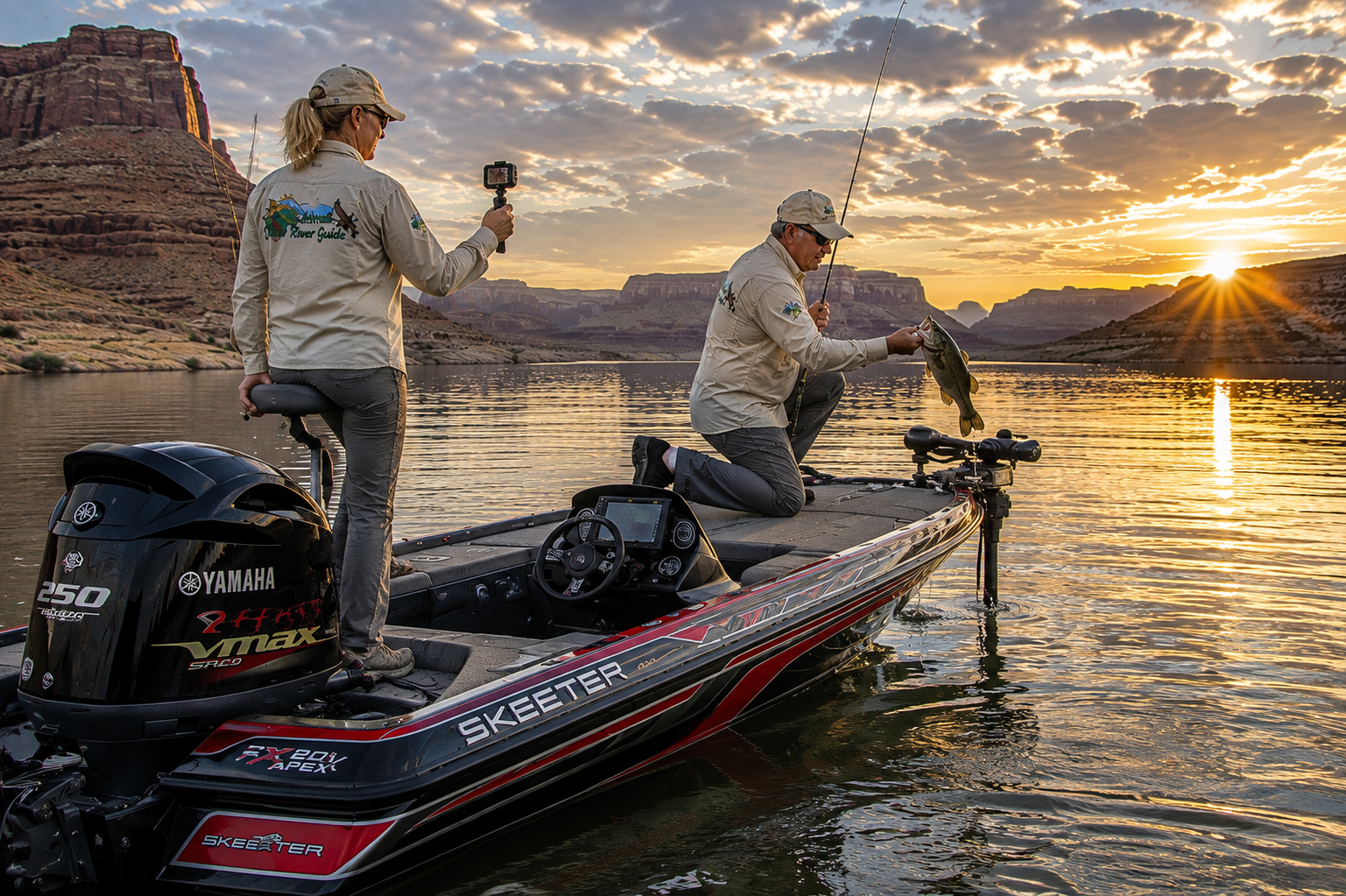
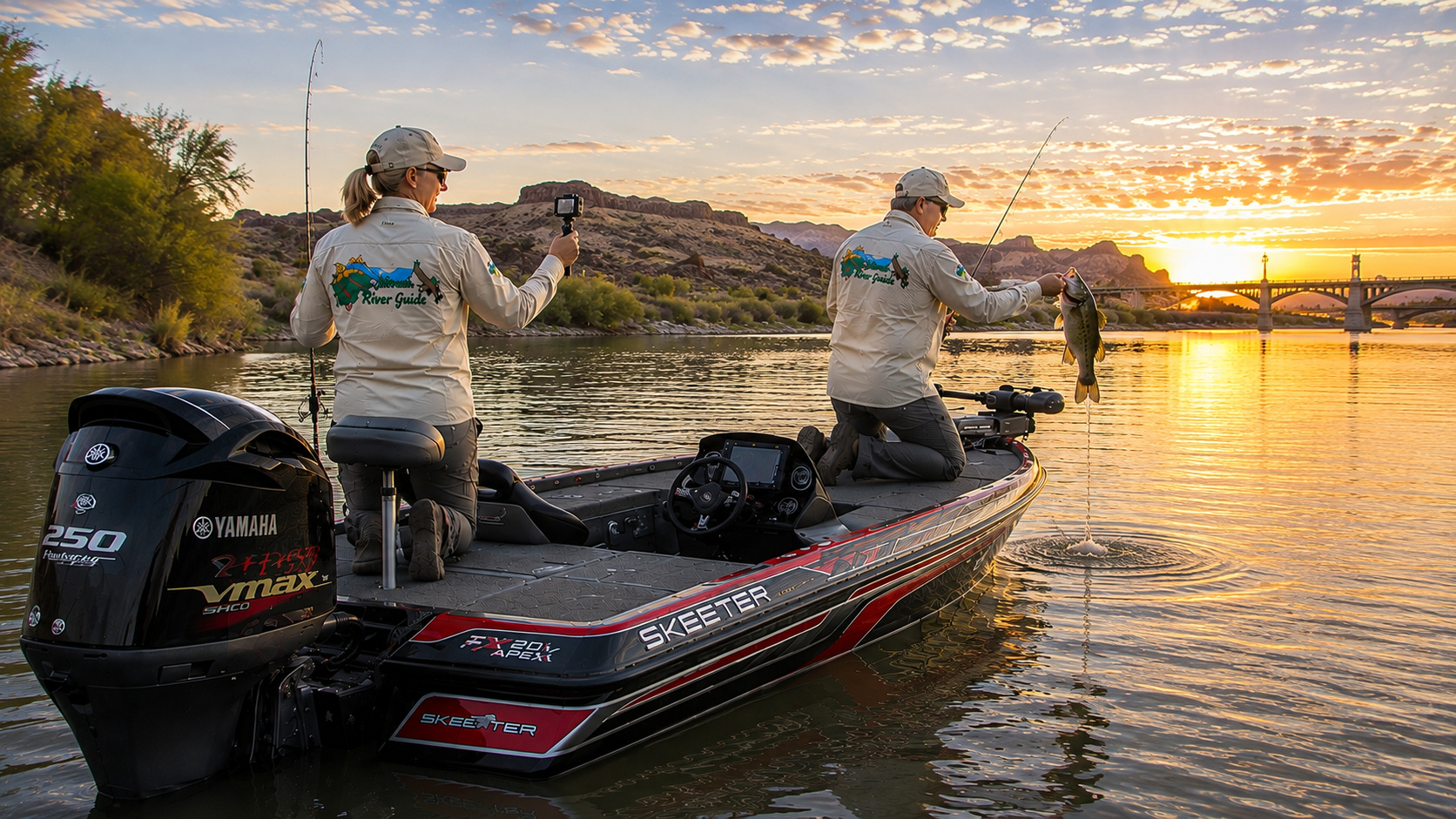
The Skeeter settles into the water and the Yamaha is barely warm when we turn toward a protected cove.
The desert mountains are catching first light.
Water beneath the boat is clear enough that I can see rock twenty feet down.
We idle outside the pocket.
I shut down the Yamaha.
Lower the trolling motor.
Quiet now.
The boat slides toward shore.
I'm standing on the front deck wearing polarized glasses, looking.
Not casting.
Looking.
Rock.
Sand.
Gravel.
Another rock.
Then something moves.
I stop the trolling motor.
There she is.
A smallmouth.
Good fish.
She's holding beside a pale patch on the bottom.
I back away.
Pick up the spinning rod.
Check the knot.
Paulette knows exactly what's happening. She's seen this routine more than a few times.
The first cast is too far right.
The fish turns toward it but doesn't commit.
Second cast.
Better.
The bait drops onto the edge of the bed.
The smallmouth approaches.
Stops.
Turns sideways.
I twitch the rod.
She moves forward.
And I can see every bit of it.
The mouth opens.
The line jumps.
I set the hook.
For the next few seconds, I'm not an octogenarian.
I'm the Kansas ranch kid who discovered fishing all over again.
The smallmouth jumps beside the boat.
Bronze sides flashing in the morning sun.
I kneel beside the trolling motor, reach over the gunwale and lip her.
Water pours from her tail.
Paulette has the camera.
Click.
One photograph.
Then the fish goes back.
I hold her in the water until she kicks free.
She disappears through that gin-clear water and returns toward the bed.
I sit there for a moment watching.
That's enough.
More than enough.
After all these miles following the Colorado River, we've finally entered our winter home country.
Lake Mead today.
Lake Mohave next.
And somewhere downstream beyond Lake Havasu, the river is still heading for Mexico.
We've got a ways to go.
But from here on down, we're traveling familiar water.
And that makes this old fisherman feel very much at home.
0 Comments