There are places along the Colorado River where I feel like a visitor.
Lake Havasu isn't one of them.
By the time Paulette and I reach Havasu from our winter home near Lake Mohave, we've already crossed a lot of familiar desert. Katherine Landing and the Black Mountains are behind us. The river has passed Davis Dam, Bullhead City and Laughlin, wandered through the Mohave Valley and squeezed between the rugged walls of Topock Gorge.
Then the canyon begins opening.
The current relaxes.
The horizon gets wider.
And the Colorado becomes Lake Havasu.
Lake Mohave will probably always be our favorite winter fishing lake because we live right above it. But if Mohave is our home water, Havasu is the neighbor whose invitation to go fishing is very difficult to turn down.
Especially in spring.
This is one spectacular bass lake.
Clear water. Rock. Tules. Artificial habitat. Backwaters. River influence. Healthy largemouth. Hard-fighting smallmouth. Stripers chasing shad.
And during the spring spawn, enough shallow bass to keep an old sight fisherman staring into the water until his neck reminds him he's no longer thirty.
But Lake Havasu has another personality.
By midday, particularly on warm weekends, holidays and during major boating events, the quiet fishing lake we launched onto before sunrise can become an entirely different piece of water.
Performance boats.
Wake boats.
Personal watercraft.
Cruisers.
Pontoon boats.
Party boats.
And wakes arriving from several directions at once.
So our Havasu routine is pretty simple.
Get there early. Fish hard. Enjoy the sunrise. And when the lake starts getting rowdy after noon, don't argue with it.
The bass will still be there tomorrow morning.
From Topock Gorge Into Lake Havasu
Our journey into Havasu begins where our Colorado River Topock Gorge fishing adventure leaves off.
Topock Gorge is one of the last relatively natural reaches of the lower Colorado River. The U.S. Fish & Wildlife Service protects roughly 20 miles of natural river channel there as part of Havasu National Wildlife Refuge. The refuge encompasses 37,515 acres and protects about 30 river miles between the Needles area and Lake Havasu City. (U.S. Fish and Wildlife Service)
Coming downstream by boat, the transition is gradual.
One moment I'm still reading river current, looking for eddies and current breaks.
Then the water begins widening.
Current becomes less obvious.
Points and offshore structure become more important.
I stop thinking primarily like a river fisherman and start thinking like a reservoir bass fisherman again.
That's Lake Havasu.
How Big Is Lake Havasu?
Lake Havasu was created by Parker Dam, constructed across the Colorado River between Arizona and California from 1934 to 1938.
The Bureau of Reclamation lists the reservoir at approximately:
45 miles long
20,400 surface acres
32 square miles
and roughly 646,200 acre-feet of total storage capacity. (USBureau of Reclamation)
It is considerably smaller than Lake Mead.
But don't let acreage fool you.
Havasu packs an extraordinary amount of fishable habitat into those 20,000 acres.
It also serves a purpose much larger than recreation. Parker Dam creates storage for water diverted into both the Colorado River Aqueduct, which carries water toward Southern California, and the Central Arizona Project, which carries Colorado River water into central and southern Arizona. (USBureau of Reclamation)
So while I'm standing on the front deck wondering whether a smallmouth wants green pumpkin or watermelon, this lake is simultaneously helping supply water to millions of people.
That's quite a day job.
Lake Havasu Water Levels in 2026
Havasu's water-level situation is dramatically different from Lake Mead.
The Bureau of Reclamation's 2026 Annual Operating Plan calls for Lake Havasu to be regulated within a relatively narrow range of approximately 446 to 450 feet elevation.
The reservoir is normally drawn down somewhat during late summer and fall, then filled during winter as water-management and powerplant operations change seasonally. (USBureau of Reclamation)
That's important for bass fishermen.
Four vertical feet doesn't sound like much.
On a gently sloping spawning flat, however, four feet of elevation change can move the shoreline a long way horizontally.
It changes:
Tule depth.
Spawning shelves.
Shallow brush.
Rock transitions.
Backwater entrances.
Artificial habitat depth.
And access to some shoreline cover.
I never assume that because a bed was in four feet of water last April, the same patch of gravel will be in four feet this April.
The bass don't fish old photographs.
Neither should I.
The Colorado River Is Lake Havasu's Main Feeder
The Colorado River is overwhelmingly the principal water source entering Lake Havasu from the north.
That water has already traveled an astonishing distance.
It began as snow and runoff high in the Rocky Mountains.
It passed through Grand Lake.
Crossed Colorado.
Entered Utah.
Mixed with the Green River.
Filled Lake Powell.
Passed through Glen Canyon Dam.
Carved through Grand Canyon.
Entered Lake Mead.
Passed Hoover Dam.
Filled Lake Mohave.
Passed Davis Dam.
Flowed through Topock Gorge.
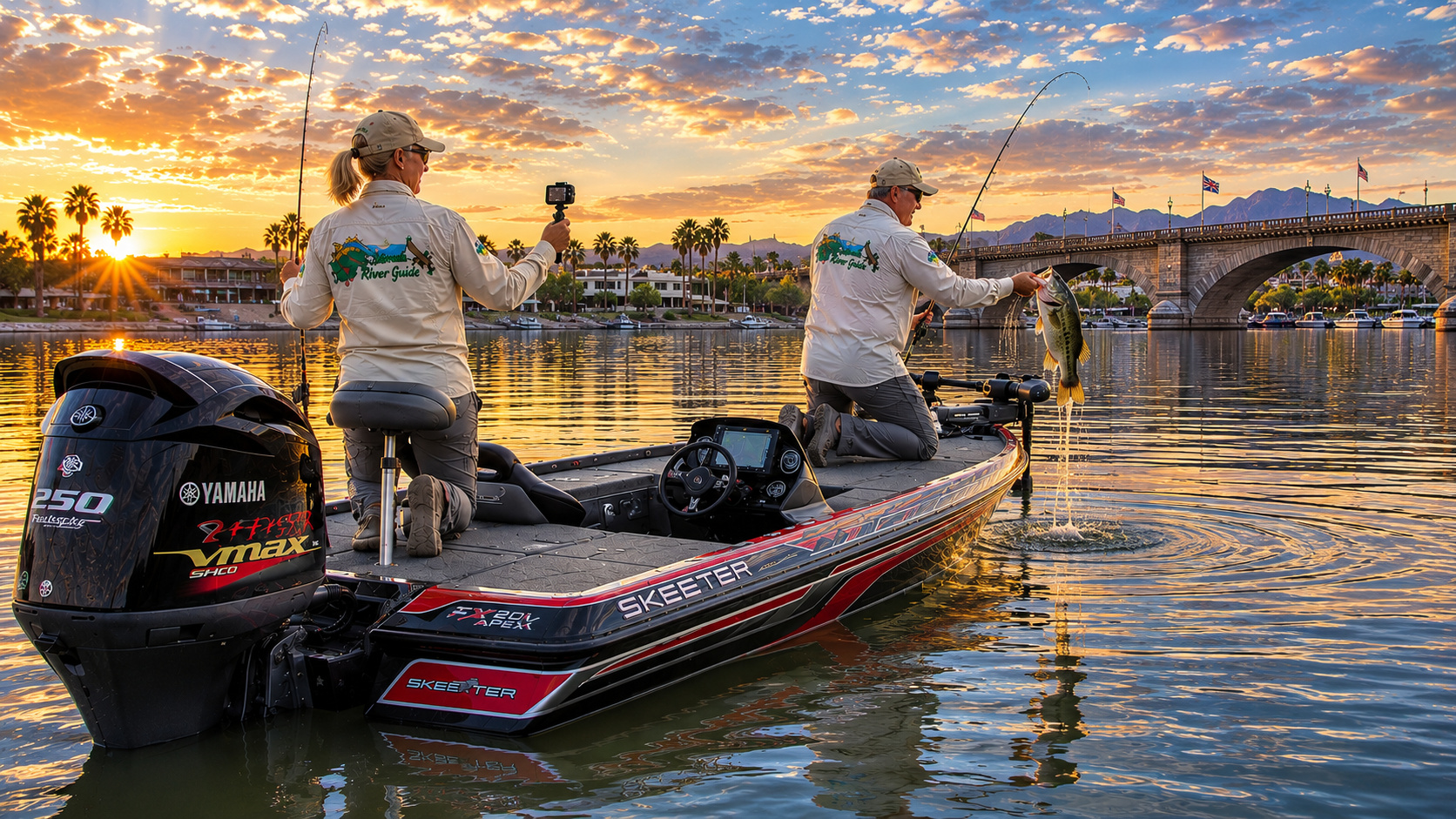
And now it's beneath our Skeeter.
That's a thought I never tire of.
The Bill Williams River
At the southern end of Lake Havasu, another important river enters from Arizona.
The Bill Williams River drains west-central Arizona and provides one of the most interesting ecological areas around the lake.
Arizona Game and Fish identifies largemouth bass, bluegill and channel catfish within the Bill Williams system, although access varies. The river corridor is also important habitat for native wildlife and aquatic conservation. (Arizona Wildlife Conservation Strategy)
Reclamation's 2026 operating plan notes that Bill Williams flows are regulated upstream by Alamo Dam and that not every release from Alamo Lake necessarily reaches Havasu. (USBureau of Reclamation)
For a fisherman, the southern lake near the Bill Williams can feel very different from the clearer, rockier portions farther north.
That's one reason Havasu supports both largemouth and smallmouth so well.
It gives each species plenty of places to behave like itself.
Geography: Where the Mojave and Sonoran Deserts Meet the River
Lake Havasu sits in remarkable desert country.
To the east lies Arizona.
California forms the western shore.
The lake occupies part of the lower Colorado River valley near the transition between Mojave and Sonoran desert influences.
Mountains rise abruptly from otherwise open desert.
Volcanic rock appears along portions of the shoreline.
Canyons cut into surrounding uplands.
Broad flats alternate with steep rocky banks.
And the Colorado provides a ribbon of life through country that can otherwise look impossibly dry.
The contrast is what gets me.
Blue water.
Brown desert.
Black volcanic rock.
Green tules.
Then a brilliant Arizona sky overhead.
A photographer could stay busy here without ever picking up a fishing rod.
Fortunately, I don't see any reason to choose between the two.
Ancient People and the Colorado River
As we've found throughout this journey, the Colorado River was home long before it became recreation.
Native peoples lived, traveled, farmed, hunted, fished and traded throughout the lower Colorado corridor for thousands of years.
The Mojave people developed an especially intimate relationship with the river and its floodplain. The Colorado provided fertile soils, water and a transportation corridor through an otherwise difficult desert environment.
This is important to remember because modern Lake Havasu can make the landscape seem surprisingly new.
Parker Dam dates only to the 1930s.
Lake Havasu City dates to the 1960s.
London Bridge arrived in the desert in the late 1960s.
But the human relationship with the Colorado River is ancient.
The lake is new.
The river story isn't.
Lake Havasu City: Somebody Looked at Empty Desert and Saw a Town
The modern history of Lake Havasu City is one of those distinctly American stories I enjoy.
In the early 1960s, entrepreneur Robert McCulloch saw potential in the largely undeveloped Arizona shoreline while looking for a place to test outboard motors.
Lake Havasu City was established in 1963.
Today it has grown into a community of more than 56,000 residents and a major boating and recreation destination. (Lake Havasu City)
And then McCulloch did something that must have sounded absolutely ridiculous when first proposed.
He bought London Bridge.
Not a copy.
The bridge.
London Bridge Comes to Arizona
The London Bridge now crossing Bridgewater Channel originally crossed the River Thames in England.
The bridge designed by John Rennie opened in London in 1831. By the twentieth century it was no longer suitable for London's increasing traffic and was eventually offered for sale.
McCulloch purchased it in 1968.
The exterior granite blocks were dismantled, numbered, shipped across the Atlantic, passed through the Panama Canal to California and then traveled overland to Arizona.
A modern reinforced-concrete structure was built and clad with the historic granite.
The reconstructed bridge was dedicated at Lake Havasu City on October 10, 1971, before more than 50,000 spectators and dignitaries. (Lake Havasu City)
Then comes my favorite part.
The bridge was initially reconstructed on dry land.
Afterward, Bridgewater Channel was dredged underneath it, turning the former peninsula into an island. (Lake Havasu City)
That takes a particular kind of confidence.
Most people build a bridge after discovering they need to cross water.
McCulloch essentially built the bridge and then supplied the water.
I admire that.
Bridgewater Channel
Today the channel beneath London Bridge is one of Lake Havasu City's defining features.
It is also a busy recreational boating corridor.
Restaurants, beaches, docks and businesses line portions of the channel.
The lake's famous Island lies on the west side.
During quiet periods, it's a pleasant place to idle through.
During busy weekends?
Different story.
I am not trying to establish a new trolling-motor speed record through Bridgewater Channel.
I slow down.
Watch ahead.
Watch behind.
Watch for swimmers and paddlecraft.
And assume someone somewhere is about to do something I didn't predict.
That philosophy has served me well around boats for a long time.
Lake Havasu Bass Fishing Is the Real Attraction for Me
London Bridge may attract tourists.
The bass attract me.
Arizona Game and Fish currently manages Lake Havasu primarily as a high-quality largemouth and smallmouth bass fishery, with redear sunfish as a featured secondary species and striped bass providing another major fishing opportunity. (Arizona Wildlife Conservation Strategy)
That management priority tells you something.
Havasu isn't merely a lake where bass happen to live.
It's a serious bass fishery.
Arizona Game and Fish also installs artificial fish habitat throughout the reservoir and publishes GPS coordinates that anglers can load into compatible electronics. Structures include PVC habitat, woody structures and other designs intended to concentrate fish and improve angling opportunities. (Arizona Game and Fish Department)
That habitat program has become an important part of Havasu's fishing identity.
Aquatic Vegetation: Why Havasu Largemouth Have Somewhere to Live
One of the biggest differences between Havasu and Lake Mohave is vegetation.
Havasu offers more meaningful shallow cover for largemouth.
I look for:
Tules
Reeds
Submerged aquatic vegetation
Flooded brush
Docks
Artificial habitat
Backwaters
Shallow flats
Rock mixed with vegetation
Historical Lake Havasu Sports Guide reports consistently describe largemouth relating to weedbeds, emergent vegetation, docks and artificial habitat. (Lake Havasu Sports Guide)
That's classic largemouth country.
Give me a tule line beside slightly deeper water with some submerged grass nearby and I'll make a cast.
Probably several.
Smallmouth Habitat Is Different
For smallmouth, I turn toward:
Rocky points.
Gravel flats.
Canyon walls.
Rocky islands.
Submerged ridges.
Boulder fields.
Channel edges.
Artificial habitat adjacent to rock.
Clear-water points holding shad.
Old Havasu fishing reports describe smallmouth working rocky points, ridges, shorelines and canyons, with fish using deeper water during winter before moving shallower as spring approaches. (Lake Havasu Sports Guide)
That's exactly the kind of smallmouth fishing I enjoy.
And when those bronze fish move shallow to spawn in clear spring water?
Now we're talking.
January: Clear Water and Slow Fishing
January is finesse season.
Smallmouth frequently relate to deeper rock.
Largemouth may hold around vegetation, docks and artificial habitat, but cold water slows everything down.
I begin with a 7-foot medium-light spinning rod, a 2500-size reel and 8- to 10-pound braid with a 6- to 8-pound fluorocarbon leader.
For smallmouth:
2¾- to 3½-inch Ned rigs.
3- to 4-inch tubes.
Drop-shot worms.
Small football jigs.
For largemouth:
Weightless stick worms.
Drop shots.
Finesse jigs.
Slowly worked soft plastics.
Historical Havasu reports make the same point about winter fishing: slow down. (Lake Havasu Sports Guide)
Bass don't own calendars, but they certainly understand cold water.
February: Staging Begins
February is when I begin looking toward spring.
A string of warm, sunny days heats protected water.
Smallmouth begin creeping toward rocky staging areas near spawning flats.
Largemouth move toward protected coves and backwaters.
A suspending jerkbait becomes one of my favorite tools.
I use:
3½- to 5-inch jerkbaits.
Ghost shad.
Translucent silver.
Natural minnow patterns.
Long pauses in cold water.
I also keep a drop-shot close.
Havasu's clear water rewards subtlety.
March: Bass Start Coming Shallow
March is one of my favorite months.
Water temperatures begin moving through the 50s and toward the 60s.
Smallmouth position on rocky points and gravel flats.
Largemouth begin entering spawning coves and tule pockets.
Historical Havasu reports found smallmouth feeding around primary points near shad and crawfish in roughly the 10- to 15-foot zone as spring developed. (Lake Havasu Sports Guide)
This is when polarized glasses start spending more time on my face than in the glove box.
I'm looking.
Beds.
Cruisers.
Bass staging outside beds.
A flash beneath the boat.
A shadow beside a rock.
Spring has arrived.
April: Sight-Fishing Season
April can be magic.
This is one reason Paulette and I make the trip from Lake Mohave.
Sight fishing spawning smallmouth and largemouth in clear water is one of my favorite forms of bass fishing.
I don't race through a spawning cove.
The Yamaha gets shut down well outside.
Trolling motor goes into the water.
Then we ease forward.
Slowly.
I want the bass to reveal itself before I reveal myself.
For bed fishing, I use:
3-inch tubes.
Ned rigs.
Small craws.
Drop-shot worms.
Compact creature baits.
Sometimes white plastics.
Why white?
Because I can see them.
When I'm watching a bass respond to a bait on a bed, knowing exactly where the lure is can be more important than choosing a color that looks natural to me.
The fish will tell me whether she agrees.
May: Post-Spawn Bass and Topwater
May begins mixing patterns.
Some bass may still be spawning.
Others guard fry.
Others have already recovered and begun feeding aggressively.
This is when topwater comes alive.
Walking baits.
Poppers.
Frogs around suitable vegetation.
Soft-plastic jerkbaits.
Spinnerbaits.
Swimbaits.
I especially like fishing early.
By midmorning, boat traffic begins increasing.
By afternoon?
Well, we'll get to that.
June: Follow the Shad
June shifts the focus toward forage.
Smallmouth move toward rocky points and offshore structure.
Largemouth may remain around vegetation and docks early, then move toward deeper cover as sunlight intensifies.
I use:
3- to 5-inch swimbaits.
Crankbaits.
Drop shots.
Football jigs.
Topwater at dawn.
The trick is following the fish rather than fishing where they were in April.
Bass are inconsiderate that way.
They move.
July and August: Beat the Heat and the Boat Traffic
Summer changes everything.
This is when I want the boat launched before daylight.
The desert is cooler.
The lake is quieter.
Bass feed shallow.
Stripers may push shad toward the surface.
And most importantly, we get several hours before recreational traffic becomes heavy.
By afternoon, Lake Havasu can become rowdy.
There is no gentler word for it.
Warm-weather weekends can bring large numbers of performance boats, wake boats, personal watercraft and recreational cruisers.
I don't want to be trying to hold the Skeeter on a subtle offshore smallmouth spot while wakes are coming from four directions.
So we fish early.
When the circus arrives, we can leave the tent.
September: The First Turn Toward Fall
September remains hot, but nights slowly lengthen.
Bass begin responding to changing forage patterns.
Smallmouth work rocky structure and shad.
Largemouth become increasingly active around vegetation and backwater mouths.
Stripers can begin providing exciting schooling action.
This is when I watch birds.
Birds are some of the finest fish-finding electronics ever manufactured.
If they're diving, I investigate.
October: One of Havasu's Best Months
October is hard to beat.
Temperatures become reasonable.
Bass feed.
Stripers chase bait.
Pleasure-boat traffic begins easing.
For largemouth:
Jigs.
Spinnerbaits.
Soft-plastic stickbaits.
Crankbaits.
For smallmouth:
Football jigs.
Tubes.
Swimbaits.
Crankbaits.
Historical Havasu reports have documented excellent fall largemouth action around tules and weedline edges and smallmouth around gravel flats and rocky outcrops. (Lake Havasu Sports Guide)
That pattern makes perfect sense to me.
November: Follow the Bait
November gives us some of the nicest fishing weather of the year.
Stripers continue feeding on shad.
Smallmouth remain active around rock.
Largemouth use vegetation and artificial habitat.
Jerkbaits become increasingly important as water cools.
I like translucent colors in Havasu's clear water.
The less my lure resembles a painted piece of plastic, the happier I am.
December: Back to Finesse
December completes the cycle.
Bass begin settling into winter positions.
Slow presentations regain importance.
Drop shots.
Ned rigs.
Tubes.
Small jigs.
Stripers remain catchable, but schools may hold deeper.
This is when electronics earn their place at the console and bow.
I don't spend two hours fishing beautiful empty water anymore.
I've done enough of that for one lifetime.
My Lake Havasu Smallmouth Tackle
For smallmouth:
Rod: 6'10" to 7'3" medium-light spinning rod
Reel: 2500-size spinning reel
Main line: 8- to 10-pound braid
Leader: 6- to 10-pound fluorocarbon
Favorite lures:
-
2¾- to 4-inch Ned rigs
-
3- to 4-inch tubes
-
3½- to 5-inch drop-shot worms
-
3- to 4-inch swimbaits
-
3½- to 5-inch jerkbaits
-
⅜- to ½-ounce football jigs
-
Medium-diving crankbaits
-
Walking topwaters
Colors:
Green pumpkin.
Brown.
Cinnamon.
Smoke.
Watermelon.
Natural crawfish.
Ghost shad.
Pearl.
Silver.
Old Lake Havasu Sports Guide reports specifically noted cinnamon and green-pumpkin hula grubs on football heads around gravel flats and rock, a pattern that remains entirely logical for Havasu smallmouth. (Lake Havasu Sports Guide)
My Lake Havasu Largemouth Tackle
For largemouth:
Rod: 7-foot medium-heavy casting rod
Reel: 7:1 baitcaster
Line: 12- to 17-pound fluorocarbon
Around thick vegetation I may switch to braid.
Favorite lures:
-
⅜- to ½-ounce jigs
-
Texas-rigged worms
-
4- to 6-inch stick worms
-
Creature baits
-
Spinnerbaits
-
Vibrating jigs
-
Shallow crankbaits
-
Frogs
-
Soft jerkbaits
-
Walking baits
Colors:
Green pumpkin.
Watermelon.
Junebug.
Black-and-blue.
White.
Shad patterns.
Natural crawfish.
The presence of vegetation gives me more reasons to keep heavier casting tackle ready here than I normally would on Lake Mohave.
Lake Havasu Striped Bass
Stripers add an entirely different kind of fishing.
Arizona Game and Fish identifies Lake Havasu as a striper destination, although current management places the strongest emphasis on black bass. (Arizona Wildlife Conservation Strategy)
Stripers follow forage.
That means my most important piece of equipment may be the sonar.
Find shad.
Find birds.
Find arches beneath the bait.
Then fish.
My striper tackle:
Rod: 7- to 7½-foot medium-heavy
Reel: 3000-4000 spinning reel or sturdy baitcaster
Line: 15- to 30-pound braid with leader as needed
Lures:
-
½- to 1½-ounce spoons
-
3- to 6-inch swimbaits
-
Jerkbaits
-
Lipless crankbaits
-
Walking topwaters
-
Poppers
Colors:
Pearl.
White.
Silver.
Chrome.
Threadfin shad.
Historical Havasu reports also document live shad, cut anchovies, trolling and bottom fishing as productive striper methods. (Lake Havasu Sports Guide)
When stripers boil on the surface, forget finesse.
Cast.
Fast.
How Deep Should I Fish Lake Havasu?
There is no single answer.
During the spawn, bass can be almost embarrassingly shallow.
A largemouth may sit in two feet among tules.
A smallmouth may spawn on a gravel shelf in five to fifteen feet depending upon water clarity and conditions.
Summer and winter can push fish considerably deeper.
Stripers may be near the surface during a boil and thirty or forty feet down an hour later.
I divide the water column roughly this way:
0-10 feet: spawning fish, vegetation, tules, topwater, shallow rock.
10-25 feet: points, artificial habitat, smallmouth, transition structure.
25-50+ feet: winter smallmouth, summer fish, deep stripers and offshore schools.
But I trust the electronics more than rules.
Fish can't read fishing articles.
Artificial Fish Habitat: One of Havasu's Great Fishing Assets
Lake Havasu's habitat program deserves special mention.
Arizona Game and Fish publishes GPS-enabled files showing installed habitat structures throughout the reservoir. These may include PVC, wood and other materials placed over roughly acre-sized areas. (Arizona Game and Fish Department)
These structures benefit fishermen because they concentrate fish.
But they also compensate, at least partly, for habitat lost when a free-flowing river became a regulated reservoir.
I treat habitat coordinates as starting points rather than magic dots.
I approach with sonar.
Look for the structure.
Look for bait.
Look for fish.
If all three are present, I stay.
Mesquite Bay: Quiet Water in a Busy Lake
For shore anglers and paddlers, Mesquite Bay offers something particularly valuable.
Quiet.
The Fish & Wildlife Service maintains North and South Mesquite Bay within Lake Havasu City. Both have fishing piers and constructed underwater fish habitat.
Most importantly, motorized watercraft are prohibited.
Kayaks and canoes are allowed. (U.S. Fish and Wildlife Service)
On a summer afternoon when the main lake sounds like an outboard convention, Mesquite Bay can feel like somebody found the mute button.
Lake Havasu Records
Lake Havasu has produced some remarkable fish.
Arizona's current Colorado River catch-and-release records include a 23-inch smallmouth bass caught at Lake Havasu in January 2023. (Arizona Game and Fish Department)
Havasu is also famous for enormous redear sunfish.
Arizona Game and Fish documents a 6-pound, 4.8-ounce, 17-inch redear caught from Lake Havasu in 2021. (Arizona Game and Fish Department)
That is a sunfish built like somebody accidentally inflated it with an air compressor.
The current Colorado River catch-and-release redear record is 16 inches, also from Lake Havasu, recorded in 2025. (Arizona Game and Fish Department)
Arizona's broader Colorado River records also show just how capable this lower river system is of producing trophy black bass, including a 28-inch largemouth catch-and-release record from the lower Colorado. (Arizona Game and Fish Department)
For current certified weight records, I recommend checking the Arizona and California record books immediately before publication rather than relying on old fishing-site lists.
Catch and Release
A big Havasu bass deserves better than a prolonged photo session.
My routine is straightforward.
Land it efficiently.
Wet my hands.
Keep it off the hot carpet.
Lip it properly.
Support a large bass horizontally when necessary.
Have the camera ready before lifting the fish.
Take the photograph.
Release it.
During the spawn, this becomes even more important.
If I catch a bass from a bed, I want that fish returned to the same area quickly.
There may be eggs or fry depending upon it.
The photograph belongs to me.
The fish belongs to Lake Havasu.
Wildlife Around Lake Havasu
Paulette and I never go anywhere in this country without watching for wildlife.
Havasu National Wildlife Refuge alone has documented 318 bird species. Desert bighorn sheep inhabit Topock Gorge, while coyotes, foxes, bobcats and mountain lions occur within the refuge landscape. Peregrine falcons work the canyon cliffs, and thousands of bats emerge from old mines. (U.S. Fish and Wildlife Service)
Around the lake I watch for:
Desert bighorn sheep.
Coyotes.
Bobcats.
Mule deer.
Desert cottontails.
Jackrabbits.
Bats.
Roadrunners.
Gambel's quail.
Ospreys.
Peregrine falcons.
Bald eagles seasonally.
Great blue herons.
Egrets.
Cormorants.
Grebes.
Waterfowl.
The refuge lies along the Pacific Flyway, making winter and migration periods especially interesting. (U.S. Fish and Wildlife Service)
A telephoto lens belongs in the boat.
Paulette doesn't need much convincing about that.
Boating Safety: Havasu Changes After Noon
Now we need to talk about the other Lake Havasu.
The one that wakes up after breakfast.
On quiet winter weekdays, Havasu can be wonderfully peaceful.
On a warm summer weekend?
Different lake.
Lake Havasu is a nationally known recreational boating destination. The city hosts high-performance boating events and major personal-watercraft competitions. (Lake Havasu City)
Heavy traffic means heavy wakes.
It also means closing speeds become significant.
A bass fisherman moving slowly on the trolling motor can suddenly find himself sharing water with boats moving many times faster.
So I operate defensively.
I wear the PFD underway.
I use the kill switch.
I keep navigation lights functional.
I watch mirrors and surroundings.
I don't make sudden course changes in traffic.
I avoid stopping in narrow navigation areas.
And I don't assume another boat operator sees me.
Alcohol and Boats Do Not Mix
The same rule I mentioned in Topock Gorge applies here.
The person operating my boat doesn't drink alcohol.
Sun, heat, dehydration, vibration and fatigue already work against judgment and reaction time.
I don't see any reason to add alcohol to the equation.
If other boaters choose differently, that's another reason for me to remain alert and conservative.
I'm interested in getting Paulette, myself and everybody aboard back to the ramp safely.
Catching another smallmouth isn't worth gambling with that.
Watch the Afternoon Wind Too
Boat traffic isn't the only thing capable of roughening Lake Havasu.
Wind can build significant chop across open water.
Combine wind waves with large boat wakes and the lake can become uncomfortable surprisingly quickly.
That's another reason I like dawn.
The water is often calmer.
Temperatures are cooler.
Fishing is better.
Traffic is lighter.
And the sunrise doesn't charge admission.
Marinas and Boat Ramps
Lake Havasu has excellent boating infrastructure.
Lake Havasu Marina
Lake Havasu Marina sits on the Island and provides a major motorized launch facility. The current visitor listing gives the marina seven launch lanes and fuel availability. (Lake Havasu City)
Lake Havasu State Park
Lake Havasu State Park provides extensive launching, beaches and camping close to town. Arizona State Parks lists three main boat ramps and 54 campsites, while current local launch information breaks the ramp capacity into multiple boat, PWC and oversized-vessel lanes. (Arizona State Parks)
Site Six
Site Six Launch Ramp is on the Island and has long been an important public launch and fishing location. The site began as a World War II emergency airfield and later became McCulloch's outboard testing facility. (Lake Havasu City)
The Nautical Beachfront Resort
The Nautical Beachfront Resort has guest-only launching on the Island. (Lake Havasu City)
There are additional private and public launches, but I always verify current ramp conditions and operating rules before towing to the lake.
Camping on Lake Havasu
For developed camping, Lake Havasu State Park is difficult to beat.
The park is open year-round and offers 54 campsites, beaches, boat ramps and 13 beachside cabins. (Arizona State Parks)
There are also commercial RV parks and resorts throughout Lake Havasu City.
For people seeking quieter surroundings, public lands and other recreation areas extend along portions of the Colorado River corridor.
The important desert rule remains the same:
Bring water.
Then bring more.
Rafting, Kayaking and Paddling
Lake Havasu is primarily a boating lake rather than a whitewater rafting destination.
But kayaks, canoes and paddleboards provide wonderful ways to explore protected shoreline.
Mesquite Bay is particularly appealing because motorized boats are excluded. (U.S. Fish and Wildlife Service)
Topock Gorge immediately upstream offers even better paddling through spectacular canyon scenery.
On the main body of Havasu, however, I would be extremely cautious with paddlecraft during periods of heavy motorboat traffic.
A kayak sits awfully low on the water.
Visibility matters.
Weather Through the Seasons
Winter
Winter is wonderful.
Cool nights.
Mild afternoons.
Occasional cold fronts.
Clear skies.
Less boat traffic.
Bass may require slower presentations, but the lake is comfortable.
This is our kind of weather.
Spring
Spring is bass season.
Water warms.
Smallmouth and largemouth move shallow.
Sight fishing begins.
Wildlife becomes active.
But spring winds can be strong.
March through May is my favorite fishing window.
Summer
Summer is serious desert heat.
Temperatures can soar well beyond 100°F.
Fish at dawn.
Hydrate constantly.
Use sun protection.
And don't underestimate reflected heat from a bass-boat deck.
The lake also reaches its busiest recreational period.
Monsoon Season
Thunderstorms can produce sudden high winds, lightning and runoff.
If the sky begins looking threatening, I don't wait around to see whether the storm has good intentions.
Fall
Fall may be the best all-around recreational season.
Temperatures moderate.
Bass feed.
Stripers chase shad.
Boat traffic begins easing.
And the desert becomes pleasant again.
Getting to Lake Havasu
From Lake Mohave and Bullhead City
Arizona Highway 95 runs south through the Colorado River communities toward Lake Havasu City.
For Paulette and me, this is the familiar route from our winter country near Katherine Landing.
From Needles and Interstate 40
Interstate 40 provides access from California and northern Arizona.
Travelers can reach the lake through Topock or continue toward Arizona Highway 95 and Lake Havasu City.
From Phoenix
Interstate 10 west toward Quartzsite followed by U.S. 95 and Arizona 95 provides a common route north to Lake Havasu City.
From Southern California
Interstate 10 or Interstate 40 provides access depending upon the starting point and destination on the lake.
Once in Lake Havasu City, London Bridge is difficult to miss.
Which I suppose was exactly McCulloch's plan.
Five Stops Along Our Colorado River Journey
Readers beginning here can return to my Colorado River from the Rocky Mountain Headwaters to the Gulf of California overview and follow the entire river downstream from its snowy beginning. (Colorado River Guide)
Our Colorado River Lake Mohave fishing guide explores the clear desert reservoir immediately upstream of this section.
The Colorado River Topock Gorge chapter follows the transition from flowing river into Lake Havasu and explains why that narrow reach demands extra boating caution.
Far upstream, the Colorado River Headwaters chapters show just how dramatically this river has changed since it left Rocky Mountain National Park.
And downstream, the Colorado River below Lake Havasu continues our journey toward Parker Dam, the Parker Strip and eventually the lower river country approaching Mexico.
One Last Havasu Morning
If I could design the perfect Havasu fishing day, I wouldn't start at eight.
I'd start in darkness.
Coffee made.
Boat hooked up.
Rods already rigged.
Paulette wondering whether I've brought every lure I own.
I probably have.
We launch while the eastern sky is just beginning to turn pale.
The Yamaha fires.
Navigation lights are still on.
The lake is nearly flat.
We run toward a protected spring cove and come off plane well outside it.
Engine off.
Trolling motor down.
That's an important detail.
If we're fishing, that trolling motor belongs in the water.
The Skeeter begins creeping along the shoreline.
I'm wearing polarized glasses even though the sun has barely cleared the mountains.
Rock.
Tule.
Sand.
Another patch of gravel.
Nothing.
Then Paulette says it.
"There's one."
Naturally she sees it first.
I follow where she's pointing.
Smallmouth.
Good one.
She's holding over a pale circular patch in the gravel.
I back the boat away.
Pick up the spinning rod.
Check the knot.
The first cast lands short.
The fish barely moves.
Second cast.
Better.
The little white bait drops near the bed.
Now I can see everything.
The bass turns.
Approaches.
Stops.
I shake the rod tip.
She noses down.
Her mouth opens.
The white bait disappears.
I set the hook.
The smallmouth explodes out of the water.
Sunlight hits bronze sides.
Water goes everywhere.
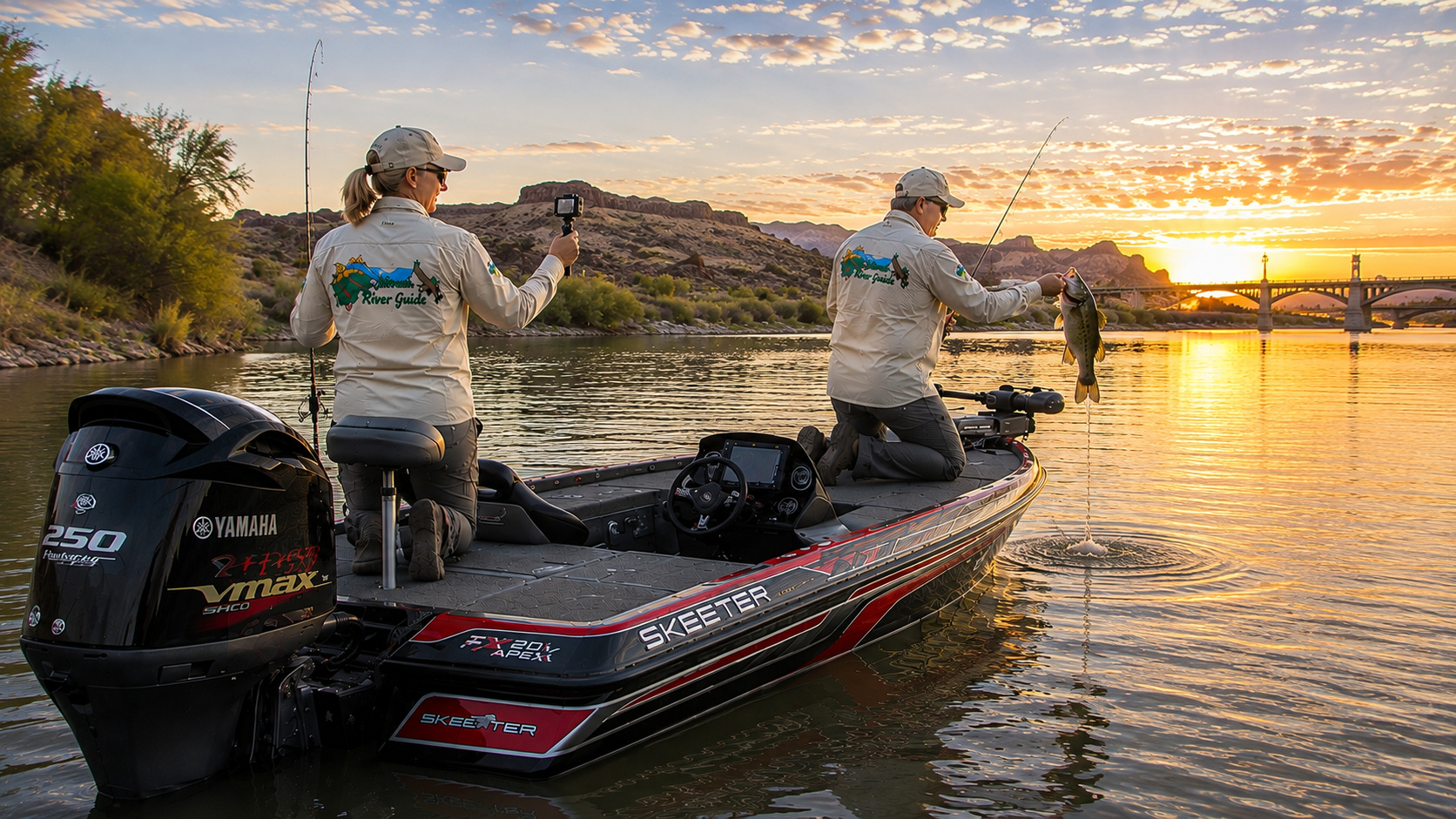
Paulette already has the action camera in her hand.
I bring the fish beside the bow.
Kneel near the deployed trolling motor.
Rod in one hand.
Lip the bass with the other.
She's three-quarters out of the water, tail still dripping.
Paulette films from the rear deck, leaning against the butt seat with her rod still in her other hand.
For a few seconds, that's the whole world.
Boat.
Bass.
Paulette.
Clear water.
Desert mountains.
Morning sun.
Then the fish goes back.
One photograph is plenty.
She disappears into the clear water and returns toward the bed.
We fish another hour.
Maybe two.
Then I begin hearing engines.
More boats appear.
A performance boat runs past in the distance.
Then another.
Wake boats arrive.
The lake begins waking up.
By noon, our quiet bass lake is turning into recreational Lake Havasu.
I look at Paulette.
She already knows.
Time to go.
That's one advantage of getting older.
I've finally learned that I don't have to win an argument with the afternoon.
We've caught our fish.
We've taken our photographs.
We've watched the desert wake up.
And we can come back tomorrow.
We idle toward the ramp.
London Bridge stands in the distance.
Somewhere beneath us, the Colorado River continues its long journey south.
It has crossed mountains.
Cut canyons.
Filled reservoirs.
Supported civilizations.
Powered cities.
Irrigated farms.
And given an old fisherman and the woman he loves another beautiful morning together.
That's plenty for one day.
Tomorrow?
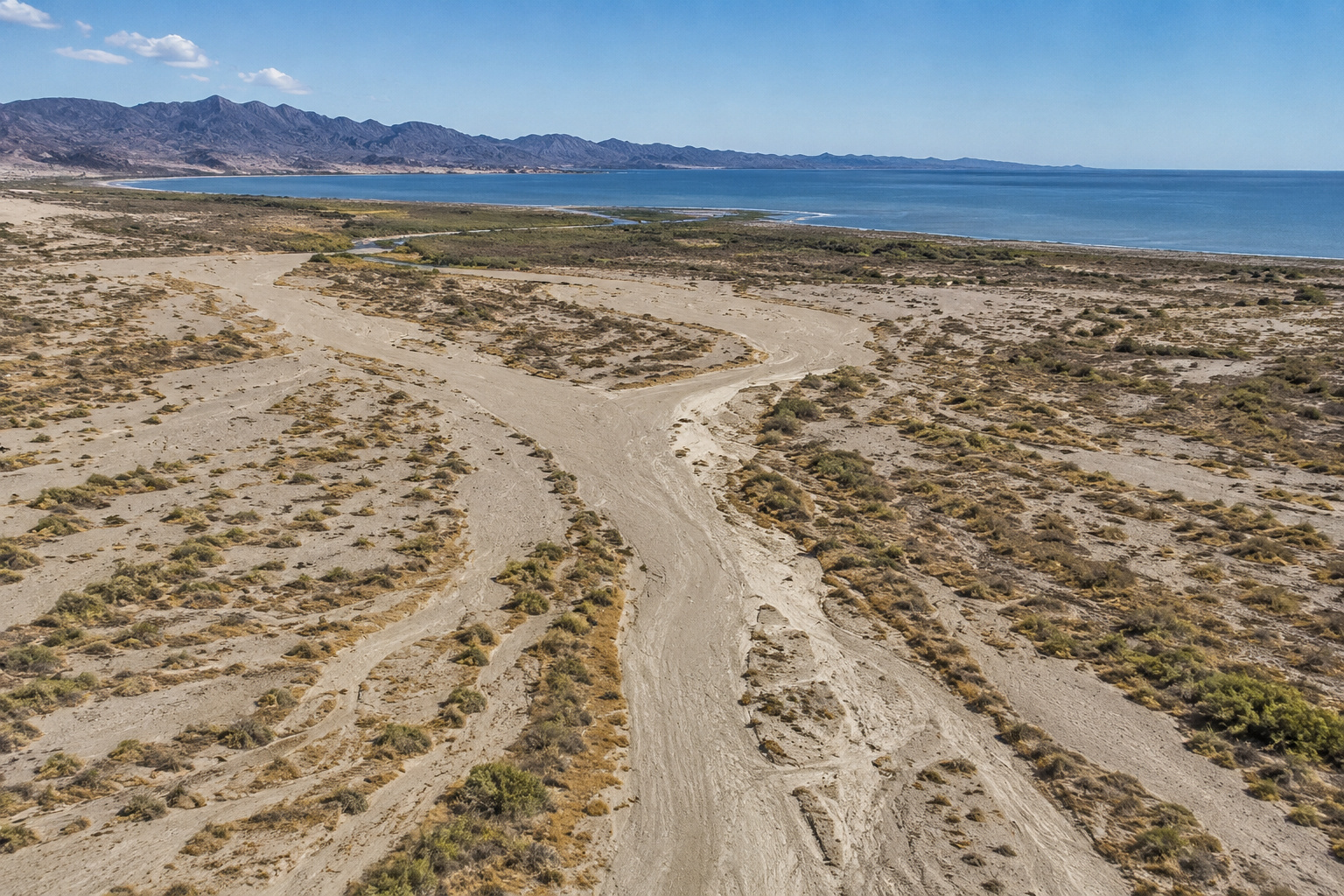
We'll follow the river below Parker Dam.
The Colorado is about to become a river again.
And we've still got a long way to Mexico.
0 Comments