Colorado River Grand Lake to Granby Colorado: In Search of Colorado Moose
There are mornings in the mountains when I carry a fishing rod.
There are other mornings when the rod stays behind and I carry a camera.
When Paulette and I visit the Colorado River between Grand Lake and Granby, Colorado, one animal in particular can persuade me to leave the fishing tackle alone.
The moose.
More specifically, the Colorado moose, that enormous, long-legged inhabitant of willow bottoms, marshes, lakeshores and mountain river valleys.
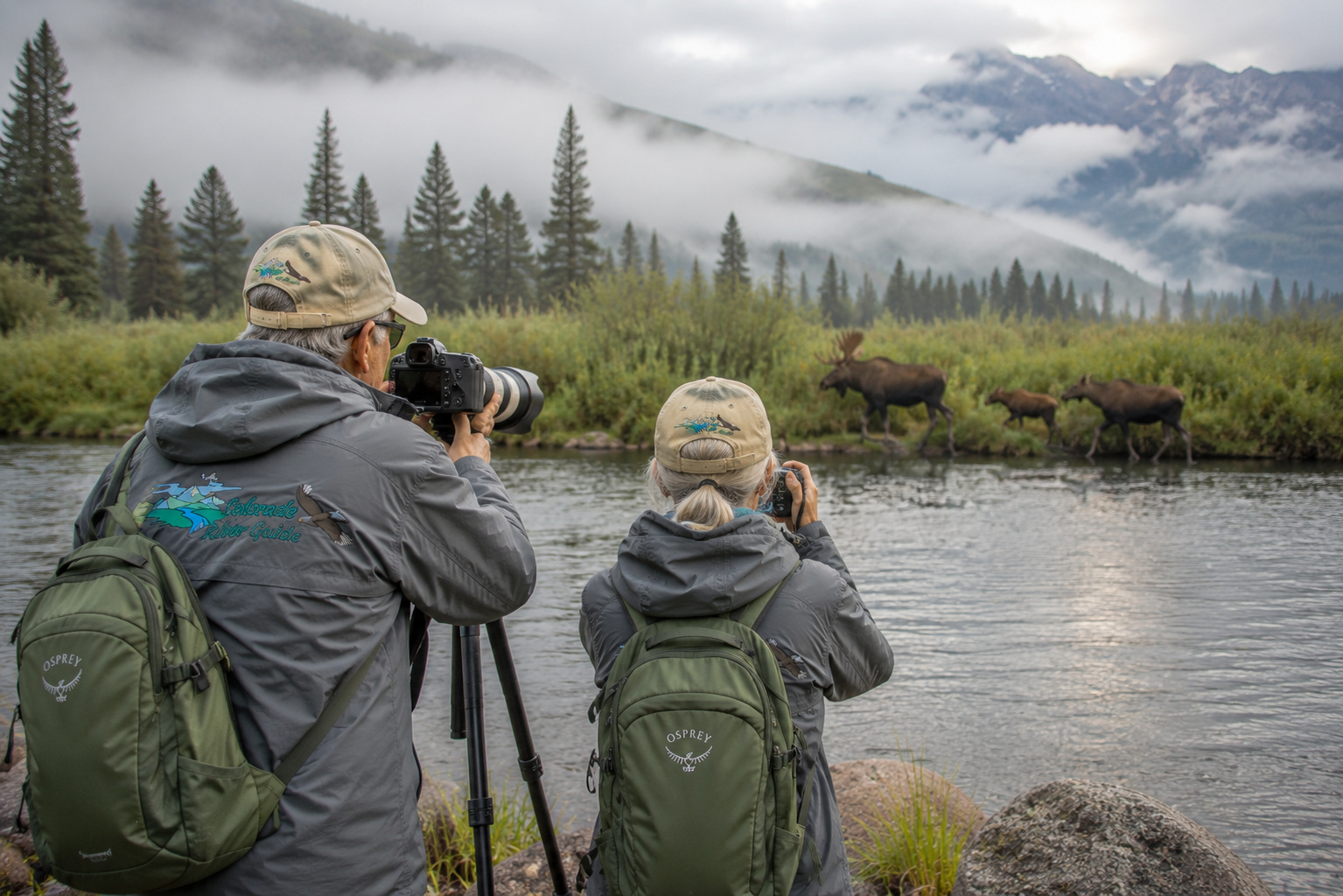
One of our primary reasons for occasionally returning to this section of the Colorado River is to photograph and video moose in some of the finest moose habitat in the Rocky Mountains. I have photographed a lot of wildlife over the years, but there is still something almost prehistoric about watching a bull moose materialize from a stand of willows in the gray light before sunrise.
First you see movement.
Then an ear.
Then that enormous dark head.
Finally the rest of him steps out, and you realize you've been looking at an animal weighing close to half a ton standing perhaps fifty yards away without knowing he was there.
That's when I quietly reach for the camera.
After more than eighty years of wandering around outdoors, I still get excited.
And I hope I always will.
This stretch of the Colorado River, from Grand Lake south through Shadow Mountain Lake and Lake Granby toward the town of Granby, is much more than a scenic mountain drive.
It is water country.
It is moose country.
And it is another remarkable chapter in our journey down the Colorado River.
Leaving Grand Lake and Following the Colorado River South
In the previous chapter of our journey, we followed the young Colorado River from its Rocky Mountain headwaters through the Kawuneeche Valley to Grand Lake.
Here the geography begins changing.
The little river that started as snowmelt near the Continental Divide has entered a complicated natural and engineered water system.
Grand Lake sits at about 8,367 feet above sea level, nestled against the western edge of Rocky Mountain National Park.
Immediately south lies Shadow Mountain Lake, also commonly called Shadow Mountain Reservoir.
Continue south and the water reaches Lake Granby, a much larger reservoir impounded by Granby Dam.
Eventually the Colorado River emerges below Granby Dam and resumes its journey westward.
The sequence looks deceptively simple:
Colorado River → Grand Lake → Shadow Mountain Lake → Lake Granby → Colorado River
But water doesn't merely drift naturally through this system anymore.
The Grand Lake, Shadow Mountain and Lake Granby complex forms an important part of the enormous Colorado-Big Thompson Project, which stores and moves water from the western side of the Continental Divide to Colorado's eastern slope.
So while Paulette and I may be standing quietly beside a willow flat waiting for a moose to appear, we are also standing beside one of the West's great water-management stories.
Shadow Mountain Lake
Leaving Grand Lake southward, you almost immediately encounter Shadow Mountain Lake.
The name fits the landscape beautifully.
Mountains rise beyond the water, forests cover the slopes, and on a calm morning the entire scene can double itself in the reflection.
Shadow Mountain Reservoir was created by Shadow Mountain Dam, constructed from 1944 through 1946 on the Colorado River as part of the Colorado-Big Thompson Project.
The normal water-surface elevation is about 8,367 feet, very close to Grand Lake's elevation.
That isn't accidental.
A connecting channel allows Grand Lake and Shadow Mountain Lake to operate together hydraulically.
Shadow Mountain is relatively shallow compared with Grand Lake and Lake Granby, and its shoreline environment includes exactly the sort of wet, brushy country that attracts wildlife.
That immediately gets my attention.
Because when I'm searching for Colorado moose, I begin by searching for water and willows.
Colorado Moose: An Extraordinary Wildlife Success Story
Colorado's modern moose population has an unusual history.
Colorado Parks & Wildlife identifies the animals here as Shiras moose, Alces alces shirasi, the smallest of North America's four moose subspecies.
Calling them "small" requires a little perspective.
A mature Colorado bull can stand roughly six feet high at the shoulder and weigh more than 1,000 pounds.
That's a mighty substantial piece of wildlife.
Historical accounts indicate individual moose occasionally wandered into northern Colorado from Wyoming during the nineteenth century, but wildlife researchers have not found evidence that Colorado supported a stable breeding population during that period.
That changed in 1978 and 1979.
Colorado wildlife managers released a total of 24 moose, twelve each year, into North Park near Walden. The animals came from Wyoming and Utah.
The experiment worked.
Additional introductions followed elsewhere in Colorado.
By 2012, the state's breeding population had grown to roughly 2,300 moose.
Today, Colorado Parks & Wildlife reports more than 3,000, and recent National Park Service research citing CPW estimates places the 2025 statewide population at approximately 3,600 moose.
That represents roughly a 51 percent increase from the approximately 2,400 animals estimated in 2014.
The Rocky Mountain National Park population has been expanding as well.
Researchers estimated approximately 240 moose in the park in 2025, and population density there increased about 49 percent between 2020 and 2025.
That is an extraordinary wildlife story.
The animals are now distributed across much of Colorado's mountain country.
But the western side of Rocky Mountain National Park and the upper Colorado River remain special places to find them.
The Kawuneeche Valley: Where We Begin Looking
If Paulette and I are seriously looking for moose, I want to be up early.
Very early.
Before the parking lots fill.
Before traffic increases.
Before the bright midday sun starts flattening the mountain landscape into something a photographer has to fight.
The Kawuneeche Valley immediately north of Grand Lake is one of the first places I would look.
The National Park Service specifically recommends looking for moose in areas containing willows and aquatic vegetation and reports that visitors frequently see them along Highway 34 through the Kawuneeche Valley.
That is no coincidence.
Moose are creatures of wet country.
They favor river corridors, wetlands, marshes, lakes, ponds, willow bottoms and damp forest openings.
And the upper Colorado River gives them exactly that.
The Colorado River fly-fishing country that attracts anglers also creates the riparian corridors that wildlife needs.
But on a moose morning, I leave the fishing rod behind.
I've got a camera in my hands instead.
Understanding Moose Habitat
Finding moose consistently isn't really about finding moose.
It is about finding moose habitat.
That lesson applies to nearly every wild animal I've photographed.
Find what an animal needs and eventually you have a reasonable chance of finding the animal.
Colorado Parks & Wildlife describes moose habitat as forested country associated with lakes, marshes, rivers and wetlands.
Willow is particularly important.
During winter, moose browse heavily on willow.
During summer their diet broadens to include grasses, forbs, shrubs, leaves, conifer needles and underwater vegetation.
The National Park Service's recent Rocky Mountain National Park research shows just how important willow is.
During summer, willow can comprise about 91 percent of a moose's diet in the park.
A Kawuneeche Valley moose may consume as much as 60 pounds of vegetation in a day.
Think about that the next time you watch one standing quietly beside a river.
He isn't admiring the scenery.
He's at the buffet.
Why Moose Love Water
Those impossibly long legs aren't merely designed for walking through deep snow.
They're extremely useful in marshes.
Moose are excellent swimmers and willingly enter lakes and ponds to feed on aquatic vegetation.
Aquatic plants provide nutrients including protein and sodium.
I've always enjoyed watching the transformation.
On dry ground a moose can look awkward, almost as though somebody assembled a horse from spare parts and made the legs too long.
Put that same animal in wet country and everything makes sense.
Those long legs carry him through deep marsh vegetation.
The broad hooves work well in soft ground.
The long muzzle reaches vegetation other animals cannot easily browse.
A moose isn't poorly designed.
We were simply looking at him in the wrong habitat.
Searching Shadow Mountain Lake for Moose
South of Grand Lake, Shadow Mountain Lake provides another promising landscape.
I wouldn't expect a moose behind every willow, of course.
Wildlife photography doesn't work that way.
That's why it's still interesting.
I look for protected coves, marshy edges, willow stands, slow-moving water, fresh tracks and places where wet meadows meet forest.
Early morning is my favorite.
The water may still be holding a little mist.
The mountains are beginning to catch sunlight while the shoreline remains in shadow.
A cow and calf might step from the timber.
Or perhaps a bull is feeding alone along the edge.
Moose generally live singly or in small groups rather than forming the large herds we associate with elk.
That makes every encounter feel personal.
One animal.
One patch of willow.
One quiet morning.
And one photographer trying very hard not to spoil it.
Moose Reproduction
The annual cycle of a moose gives photographers important clues about behavior.
Colorado Parks & Wildlife reports that breeding occurs primarily during late September and early October.
This is the rut.
Mature bulls that may have spent much of the year alone begin seeking cows.
Bull moose grow antlers annually. Growth begins under soft, blood-rich velvet, and the velvet is rubbed away as breeding season approaches.
During the rut, bulls may spar with one another and become considerably more aggressive.
This is not the time to see how close you can get for a photograph.
A bull moose can run around 35 miles per hour.
I cannot.
Case closed.
After a gestation of approximately eight months, cows generally give birth in late May or early June.
Newborn calves have a reddish-brown coat without the white spots found on deer fawns.
Cows may produce twins.
A cow with a young calf deserves enormous respect and plenty of room.
She may interpret your innocent desire for a photograph quite differently than you do.
A telephoto lens is cheaper than an ambulance ride.
Photographing Colorado Moose Safely
My approach to wildlife photography has changed over the years.
When I was younger, getting closer sometimes seemed important.
These days I would rather let the lens do the walking.
Moose can appear wonderfully calm right up until they aren't.
Never crowd one.
Never block its route.
Never place yourself between a cow and calf.
Never approach a bull during the rut.
And never assume that because other tourists are standing too close, the distance must therefore be safe.
I watch the animal.
If a moose stops feeding and begins paying more attention to me than to breakfast, I have already become part of his morning.
That's my signal to give him more room.
The photograph I want is a wild moose behaving naturally.
Not a wild moose reacting to me.
From Shadow Mountain to Lake Granby
The water story becomes especially interesting south of Shadow Mountain.
Lake Granby is much lower than Grand Lake and Shadow Mountain Reservoir.
Rather than simply allowing everything to flow one direction, the Colorado-Big Thompson Project can pump water from Lake Granby uphill into Shadow Mountain Lake.
The Bureau of Reclamation's Granby Pumping Plant contains three pumps capable of moving a combined 600 cubic feet of water per second.
Water can be lifted as much as 186 feet and carried approximately 1.8 miles to Shadow Mountain Lake.
From there it can move through Grand Lake and ultimately beneath the Continental Divide through the Alva B. Adams Tunnel.
That is a remarkable thing to contemplate while watching a moose feed beside the shore.
The landscape looks timeless.
The plumbing beneath the story is anything but.
Lake Granby: The Colorado River Grows Up
Then we reach Lake Granby.
This is no little mountain pond.
Granby Dam stands on the Colorado River about 5½ miles northeast of Granby.
The earthfill dam is approximately 298 feet high, and Lake Granby has a storage capacity of about 539,800 acre-feet.
It collects much of the water supply for this portion of the Colorado-Big Thompson Project, including Colorado River water and water pumped from Willow Creek.
The lake sits among mountains and forests, with an irregular shoreline containing bays, points and coves.
For recreation, it is boating and fishing country.
For us, however, the shorelines and surrounding wet habitats add another dimension.
We're still looking for moose.
Feeder Tributaries and Connected Waters
The Colorado River remains the backbone of the system, but numerous smaller waters contribute to it.
In the broader Grand Lake-to-Granby region, important waters include:
North Inlet and East Inlet, feeding Grand Lake from Rocky Mountain National Park.
Colorado River, entering the Grand Lake and Shadow Mountain system from the north.
Willow Creek, whose water can be stored in Willow Creek Reservoir and pumped into Lake Granby.
Numerous smaller mountain creeks and drainages also contribute snowmelt and runoff.
The Bureau of Reclamation reports that Willow Creek facilities divert an average of roughly 40,000 acre-feet annually into Lake Granby.
That interconnected hydrology supports forests, wetlands and riparian corridors.
And those, in turn, support wildlife.
A watershed isn't just water.
It's habitat.
Water Levels in 2026
Water levels in these reservoirs deserve attention because they influence boat access, shoreline habitat, recreation and the broader river system.
Shadow Mountain Reservoir is managed close to its normal operating elevation of about 8,367 feet. Recent Bureau of Reclamation reporting in August 2026 placed Shadow Mountain Reservoir around 90 percent of the referenced reservoir content measure.
Lake Granby is a much larger storage reservoir and its elevation can fluctuate considerably as water is stored, released and pumped through the Colorado-Big Thompson system.
For that reason, I recommend checking the Bureau of Reclamation's current reservoir data immediately before a visit rather than relying upon a fixed number printed in a travel article.
Water levels are travelers.
They don't stand still long enough for writers.
Granby Colorado
The town of Granby sits at approximately 7,935 feet and serves as an important gateway community for the upper Colorado River country.
From Grand Lake, Granby is only about 17 road miles away, yet the landscape between them contains Grand Lake, Shadow Mountain Reservoir, Lake Granby and a tremendous amount of public mountain country.
Granby provides lodging, restaurants, fuel, supplies and access to surrounding recreational areas.
It also makes an excellent base for exploring the Colorado River, Lake Granby, Arapaho National Recreation Area and nearby public lands.
Grand Lake feels tucked against the national park.
Granby feels like a mountain crossroads.
I enjoy both for different reasons.
Ancient People and This Mountain Landscape
Long before Grand Lake became a recreation destination and long before Granby Dam held back the Colorado River, people traveled these valleys.
The Ute people have especially deep connections to Colorado's mountain country.
Earlier peoples moved seasonally through the Rockies thousands of years before Europeans arrived.
Water determined travel.
Game followed water.
People followed game.
Mountain valleys provided natural travel corridors, summer hunting areas and access across the Continental Divide.
That old relationship between people, wildlife and water is explored more broadly in The Original Coloradans.
When Paulette and I stop beside the Colorado River today with cameras and binoculars, we are newcomers in comparison.
People have watched animals along these waters for a very long time.
Public Access for Moose Watching
One reason this area works so well for wildlife exploration is the abundance of public land.
To the north, Rocky Mountain National Park protects the Kawuneeche Valley.
South of Grand Lake, the Arapaho National Recreation Area encompasses Grand Lake, Shadow Mountain Reservoir, Lake Granby and surrounding recreation lands.
National forest lands extend throughout the region.
That provides opportunities for:
wildlife viewing, hiking, photography, camping, boating, fishing, paddling and scenic driving.
But public doesn't mean unrestricted.
Seasonal wildlife closures matter.
For example, the National Park Service establishes a Colorado River Bald Eagle Protection Closure from November 15 through March 15 along a corridor extending from below Shadow Mountain Lake toward Columbine Bay on Lake Granby.
Closures like that are not inconveniences to work around.
They're part of protecting the wildlife we came to see.
Camping in Moose Country
Camping is one of the finest ways to experience this section of the Colorado.
It puts you outside during the hours when wildlife is moving.
Rather than driving an hour before sunrise, you're already there.
The national recreation area and surrounding public lands provide numerous camping opportunities around Shadow Mountain and Lake Granby, with both developed and more primitive experiences depending upon location and season.
I like campgrounds near water and willow habitat.
Not because I want a moose walking through camp.
I don't.
But because dawn and dusk excursions become much easier.
Keep a clean camp.
Store food correctly.
Don't feed wildlife.
And don't turn a moose sighting into a campground circus.
If an animal wanders through, give it room.
This is his neighborhood.
We're renting a campsite.
The Four Seasons of Colorado Moose Country
Spring: Calves and Green Valleys
Spring comes slowly at these elevations.
Snow retreats from sunny slopes while shaded country may remain buried.
Willows begin greening.
The river rises with snowmelt.
By late May and early June, cow moose begin producing calves.
This can be wonderful photography season, but it requires particular caution.
A cow protecting a newborn calf is not an animal I want to crowd.
Use a long lens.
Summer: Water, Willows and Long Days
Summer is probably the easiest season for most visitors.
Road access improves.
Days are long.
Aquatic vegetation grows.
Moose spend considerable time feeding in willow-rich wetlands and around water.
NPS research indicates that summer willow consumption is enormous, making riparian habitat an obvious place to concentrate our search.
Early morning and evening offer the best combination of wildlife activity, pleasant temperatures and photographic light.
Fall: The Rut
Then the mountains turn gold.
Aspens change.
Cold returns to the mornings.
And the moose rut begins.
Late September into early October can produce dramatic bull activity.
Large bulls carry full antlers.
They search for cows.
They may spar.
It is one of the most impressive periods of the year to photograph Colorado moose.
It is also one of the times when I give bulls the most room.
Winter: The Quiet Country
Winter transforms the valley.
Snow accumulates.
Moose remain active and browse heavily on woody vegetation, particularly willow.
Their long legs give them an advantage in snow that would make travel difficult for many other animals.
Winter photography can be spectacular, but access, road conditions, extreme cold and wildlife stress all require consideration.
An animal conserving energy to survive winter doesn't need a photographer making it walk unnecessarily.
Sometimes the best photograph is the one you decide not to take.
Wildlife Beyond the Moose
We may come looking for Colorado moose, but we certainly don't ignore everything else.
This region can support:
Rocky Mountain elk
Mule deer
Black bears
Coyotes
Red foxes
Beaver
River otters
Bobcats
Mountain lions
Snowshoe hares
Marmots
Bald eagles
Golden eagles
Ospreys
Hawks
Owls
Waterfowl
Above timberline, the broader national park adds bighorn sheep, pikas and ptarmigan to the possibilities.
That's why I keep the camera ready even when the moose refuse to cooperate.
Wildlife photography has taught me that the animal you came to photograph isn't necessarily the animal that gives you the photograph of the day.
Moose and the Changing Kawuneeche Valley
There is another side to Colorado's successful moose story.
Success has consequences.
The National Park Service is studying the rapidly growing moose population because the Kawuneeche Valley's willow wetlands are already under ecological stress.
Moose are wetland specialists.
Willow is central to their diet.
Beavers also depend upon willow for food and dam-building material.
Beaver dams, in turn, spread water across floodplains and help create the wetland conditions in which willows flourish.
It is a beautifully interconnected system.
When one part changes, everything else feels it.
Recent NPS research indicates that moose numbers in Rocky Mountain National Park are now high enough that browsing pressure contributes to challenges facing already-degraded willow communities.
That doesn't make the moose a villain.
Nature doesn't divide itself into heroes and villains as neatly as we sometimes do.
It means wildlife managers have another complicated balancing act.
The same thriving moose population that gives Paulette and me such pleasure to photograph also consumes tremendous amounts of the vegetation necessary to maintain healthy wetland habitat.
That is why scientific wildlife management matters.
A Morning Along the Colorado River
This is the part I remember.
Not population graphs.
Not acre-feet.
Not reservoir elevations.
A morning.
Paulette and I are up before sunrise.
Coffee first. Some traditions are not negotiable.
Camera batteries charged.
Memory cards checked.
Telephoto lens mounted.
Binoculars where we can reach them.
Then we drive slowly toward the river.
The mountains are still dark.
The sky above them is beginning to turn pale.
We reach a stretch of willow country and stop.
Nothing.
A few minutes pass.
Still nothing.
Then one of those dark shapes moves.
I raise the binoculars.
Moose.
A cow steps out first.
Then another shape follows.
A calf.
We stay where we are.
No chasing.
No approaching.
No attempt to manufacture a better photograph.
The cow begins feeding.
The calf stays close.
Morning sunlight finally clears the ridge and catches the tops of the willows.
I raise the camera.
That is the photograph.
Not because the moose filled the frame.
Because everything came together.
The river.
The mountains.
The light.
The animal.
And the privilege of being there without disturbing any of it.
Getting to Grand Lake, Shadow Mountain Lake, Lake Granby and Granby
For most visitors coming from Colorado's Front Range, Granby and Grand Lake are reached from Denver via Interstate 70 and U.S. Highway 40, crossing the mountains toward Winter Park and Granby.
From Granby, U.S. Highway 34 runs north past Lake Granby and Shadow Mountain Reservoir to Grand Lake and the western entrance of Rocky Mountain National Park.
From Grand Lake to Granby, the road distance is approximately 17 miles.
Don't rush it.
The purpose of this particular journey isn't setting a speed record.
Watch the meadows.
Look along willow bottoms.
Scan marshy shorelines.
Use designated pullouts rather than stopping unpredictably in traffic.
During summer, Trail Ridge Road provides seasonal access across Rocky Mountain National Park from Estes Park to Grand Lake. At elevations exceeding 12,000 feet, it is one of America's great scenic roads.
But winter closes the high route, and mountain weather can close it at other times.
Always check National Park Service road conditions before relying upon Trail Ridge Road.
From Colorado Moose Country Toward the Desert
I sometimes think about the contrast between this place and where Paulette and I spend our winters.
Here I am photographing moose beside cold Rocky Mountain water.
Months later I may be beside the same Colorado River system in Arizona, surrounded by creosote, desert mountains and brilliant winter sunshine.
The transformation is extraordinary.
Readers who want to jump ahead temporarily can see that other Colorado River in my Colorado River Davis Dam and Lake Mohave guide or wander the Colorado River Heritage Trail at Lake Mohave.
Same river.
Different universe.
And that is exactly why this Colorado River journey fascinates me.
Why We Keep Coming Back in Search of Colorado Moose
I've photographed a great many animals during my years wandering around the West.
Some encounters are exciting because they're rare.
Others stay with you because of the place.
A Colorado moose beside the Colorado River gives me both.
There is that enormous dark animal feeding quietly among green willows.
Behind him are mountains built by forces beyond any human scale.
Beside him flows a river that will eventually cross much of the American Southwest.
Above him an eagle may be circling.
Somewhere downstream a fisherman is casting to trout.
And beside the road is an old fellow with a camera, trying very hard not to miss the moment.
That's enough for me.
The longer I photograph wildlife, the less interested I become in collecting photographs simply to prove I saw something.
I want the photograph to tell me where I was.
I want the river in it.
The willow.
The morning fog.
The mountains.
The light.
And if I'm fortunate, that wonderful ungainly silhouette of a moose standing knee-deep in the water.
Perhaps that is why Paulette and I keep returning.
We're not simply searching for Colorado moose.
We're searching for those mornings.
And every once in a while, somewhere between Grand Lake and Granby, Colorado, we find one.
Then the shutter clicks.
The moose disappears back into the willows.
And the Colorado River keeps flowing south.
Our journey isn't finished.
Not even close.
0 Comments